
 CA
 NZ
 UK
 US
 IND

 AU

 Share
 X (Formerly Twitter)
 Whatsapp
 Facebook
 LinkedIn
 Telegram
 Email This Article
 Copy Link
 Summarize with AI
 Chat GPT
 Perplexity

Becoming an SMSF Trustee is taking on a legal role with real responsibilities. It is more than a tax registration or an account opening. It is a position of trust under Australian law, with duties that flow from the Superannuation Industry (Supervision) Act 1993 (the SIS Act) and a wider framework of regulations, rulings, and ATO guidance. Trustees who treat the role casually tend to discover, sometimes painfully, that the law is not casual about it.
This article is a structured tour through the rules every SMSF trustee should understand before making any meaningful Investment decision. It is not a substitute for advice. It is the equivalent of a pre-flight checklist — a brief, organised walkthrough of the key items, so that you know what each one is, why it matters, and what to do about it. After reading it, you should be able to ask better questions of your professional advisers and recognise the moments when something needs more attention.
A reminder before starting. This article is general information only. It does not consider your personal circumstances or your fund's particular facts. SMSF rules, the SIS Act, the trustee covenants, contribution caps, the in-house asset thresholds, audit requirements, the preservation age, conditions of release, the transfer balance cap, and the penalty regime can all change. Always check the current position with the ATO, ASIC, or a licensed financial adviser before relying on any specific rule mentioned here.
The SIS Act in plain English
The Superannuation Industry (Supervision) Act 1993 is the central piece of Commonwealth legislation governing super funds, including SMSFs. It sets out who can be a trustee, what trustees must do, what the fund can and cannot invest in, how the fund must be administered, what reports must be lodged, and what penalties apply for breaches.
The companion regulations — the Superannuation Industry (Supervision) Regulations 1994 — Fill in the practical details. ATO rulings, determinations, and Practical Compliance Guidelines further explain how the rules are applied in particular situations.
For SMSF trustees, the SIS Act is the source code for the system. It is not necessary to know every section, but trustees should be familiar with the major themes — sole purpose, in-house Assets, arm's length, contributions, preservation, audit, and trustee duties. Each of these gets its own section below.
The ATO is the regulator of SMSFs under the SIS Act. APRA regulates other super funds. The split matters because the regulator's approach, expectations, and toolset are tailored to the type of fund.
AI-Powered Image
The trustee covenants
Trustees are bound by a set of covenants — fundamental duties — that apply to every super fund, including SMSFs. These covenants are written into the SIS Act and into the trust deed of every complying fund.
Among other things, the covenants require trustees to act honestly in all matters concerning the fund, to exercise the same care, skill, and diligence that a prudent person would exercise in managing the affairs of another person, to act in the best interests of the beneficiaries, to keep the assets of the fund separate from any other money or assets, to formulate and give effect to an investment strategy, to allow members access to information about the fund as required, and to comply with the law.
These covenants are not optional. They are the bedrock of trustee duty. Every other rule in the system is, in some sense, an expression of these covenants.
The trustee declaration that every new SMSF trustee must sign and keep on file makes the covenants explicit. New trustees often sign without reading carefully. That is a missed opportunity. The covenants are an excellent summary of what the role requires.
The investment strategy rule
Every SMSF must have a written investment strategy. The strategy must address the risk of the fund's investments, the likely return given the investment objectives, the composition of the fund's investments (including Diversification), the Liquidity of the fund's investments having regard to its expected Cash Flow requirements, the ability of the fund to discharge its existing and prospective liabilities (including pension payments), and whether the fund should hold Life insurance for its members.
The strategy is not a one-off document. It must be reviewed regularly and updated when circumstances change. The auditor checks the strategy and may flag issues if it has not been updated or is inconsistent with the fund's actual investments.
In practice, common mistakes include using a generic template that does not reflect the actual investments held, failing to update the strategy when a major change has occurred (like buying property), and treating the strategy as paperwork rather than a real planning document.
A useful approach is to write the strategy in plain language, addressing each statutory consideration honestly. If the fund is concentrated, say so and explain why. If liquidity is a concern, say so and describe the management approach. The strategy is a record of the trustees' thinking, not a Marketing document.
The sole purpose test
The sole purpose test, in essence, requires the fund to be maintained for the sole purpose of providing retirement benefits to members or their dependants. Any arrangement that gives present-day personal benefit to a member or related party — beyond what is incidental to investment — risks breaching this test.
Common areas where the sole purpose test bites include residential property used by members or relatives, collectables stored at members' homes or displayed in members' offices, vehicles used by members or relatives, and lifestyle-related investments where the personal use element is not incidental.
The test is at the heart of much SMSF compliance. Trustees should ask, before any decision: is this asset, this arrangement, this investment, genuinely focused on the long-term retirement benefit of members? Or is there a present-day benefit that I am quietly enjoying?
If the answer is the second, stop. The sole purpose test is one of the strongest tools the ATO has, and breaches can result in significant consequences including non-complying status.
The in-house asset rule
The in-house asset rule limits the value of investments in, loans to, and leases to a related party to no more than 5% of the fund's total assets, measured at Market Value at the end of each financial year.
Related parties include the fund's members, their relatives, and entities controlled by them. The 5% test is calculated at the end of the year, and if the fund is in breach, the trustees must put together a written plan to bring the percentage back below 5% by the end of the following year.
The major exception is Business real property leased to a related party, which is exempt from the in-house asset rule. This is what allows the classic "SMSF buys business premises, leases them to the related business" strategy.
Other narrow exceptions exist, including certain unit trusts that meet specific conditions and certain widely-held trusts. These exceptions are technical and should be approached only with specialist advice.
Trustees should regularly check the in-house asset percentage, particularly when the fund's overall asset value drops (because a previously compliant 4% holding can become a non-compliant 6% holding if total assets fall).
Arm's length dealing
The fund must conduct all dealings with members, relatives, and related entities on an arm's length basis. Arm's length means transactions occur on the same terms that would apply between strangers — Market Price, market rent, market Interest Rate, market conditions.
Two important consequences flow from this.
First, the ATO can deem the fund to have received market terms even where the actual terms differed. Below-market rent from a related-party tenant can be re-priced, with the fund taxed on the difference. Above-market prices paid by the fund for assets acquired from related parties can be treated as contributions, eating into the member's contribution cap.
Second, the non-arm's length income rules apply when income arises from dealings that are not at arm's length. Such income can be taxed at a punitive rate — significantly higher than the normal concessional rate — wiping out the structural advantage of the super system. The non-arm's length expense rules extend this concept to expenses incurred under non-arm's length conditions.
The protection is documentation. Whenever the fund deals with a related party, document the basis on which the terms were set. Use independent valuations. Use comparable market evidence. The cost is small compared to the potential consequences.
Contributions and the caps
Australia's super system has annual caps on contributions, and trustees must understand them.
The concessional contribution cap applies to before-tax contributions, including employer super guarantee contributions, salary sacrifice contributions, and personal deductible contributions. The cap is a dollar figure that the government adjusts from time to time. Always check the current cap. The cap is per member, not per fund.
Carry-forward rules allow members who have not used the full concessional cap in recent years to "catch up" by contributing more in a current year, subject to balance conditions. The rules are precise; check current eligibility before relying on this.
The non-concessional contribution cap applies to after-tax contributions. It is typically higher than the concessional cap and is also adjusted over time. The bring-forward rule allows certain members to bring forward two or three years of non-concessional caps into a single year, subject to balance conditions.
Excess contributions have consequences. Excess concessional contributions are added to assessable income (with an offset for contributions tax already paid) and may attract additional charges. Excess non-concessional contributions can be withdrawn from the fund with the associated Earnings taxed at the member's marginal rate.
Trustees must monitor contributions across all sources to avoid accidental breaches. This is particularly important when a member has multiple employers, makes personal deductible contributions, or interacts with bring-forward arrangements.
Borrowing rules and LRBAs
Generally, SMSFs cannot borrow. The exception is the Limited Recourse Borrowing Arrangement (LRBA), under which an SMSF can borrow to acquire a single acquirable asset, with the asset held in a separate bare trust, and the lender's recourse limited to the asset itself.
The conditions are precise. The borrowed money can be used to acquire the asset and to maintain or repair it, but not to improve it. Multiple LRBAs are allowed, each covering a separate single acquirable asset. The asset must be the kind the fund could otherwise acquire under the SIS Act — so residential property cannot be acquired from a related party using an LRBA.
Loans from related parties to an SMSF for LRBA purposes must be on arm's length terms or comply with the ATO's safe harbour conditions (which prescribe minimum interest rates, Loan-to-value ratios, loan terms, and other features). Non-arm's length loans from related parties can trigger non-arm's length income tax outcomes.
LRBAs add complexity and cost. They are not the kind of arrangement to set up casually. Specialist advice is essential.
Preservation, conditions of release, and pensions
Super is, by design, preserved — meaning it cannot be accessed until a member meets a condition of release. The most common conditions include reaching preservation age and retiring, reaching age 65 (with or without retirement), severe financial hardship (with specific conditions), compassionate grounds (with specific conditions), permanent incapacity, terminal medical condition, and death.
Preservation age is currently set by the government and has been moving over time, depending on date of birth. Always check the current rule.
Once a condition of release is met, members can access their benefits as a lump sum, an income stream (pension), or a combination. Pensions paid in retirement phase are generally tax-free up to the transfer balance cap. Above the cap, the assets supporting the excess remain in accumulation phase.
Pensions have minimum drawdown rules. The fund must pay at least a prescribed minimum amount each year, calculated as a percentage of the member's pension balance at the start of the financial year. The percentage varies by age band. Failure to meet the minimum pension can result in the fund being treated as not paying a pension at all, with adverse tax consequences. Some flexibility is granted for genuine errors, but the trustees should aim to meet the minimum precisely each year.
Pension administration is one of the most error-prone areas of SMSF management. Mistakes around commencement, commutation, partial commutation, reversionary nominations, and transfer balance cap reporting are common. Specialist advice is invaluable.
Reporting, audits, and lodgement
Every SMSF must lodge an annual return with the ATO, which combines the income tax return, the regulatory information return, and the supervisory levy payment. The return is lodged after the fund has been audited by an approved SMSF auditor independent of the trustees and the administrator.
The auditor's role is to provide an opinion on whether the financial statements are accurate and whether the fund has complied with the SIS Act. If the auditor identifies breaches above prescribed thresholds, they must report them to the ATO via an auditor contravention report.
Trustees must also keep records for the periods prescribed by law — typically several years for most records and longer for some specific items. Records include trustee declarations, minutes of trustee decisions, the investment strategy, contribution records, valuations, financial statements, and audit reports.
Pension events must be reported through the transfer balance account reporting (TBAR) system. The frequency of reporting depends on the fund's circumstances. Failure to report can create Downstream issues with the member's transfer balance account.
Late lodgement attracts penalties and ATO attention. Trustees should build a lodgement calendar and treat the deadlines as non-Negotiable.
Penalty regime
Trustee breaches of the SIS Act can attract administrative penalties expressed in penalty units. The dollar value of a penalty unit is set by government and changes over time. Always check the current rate.
Different contraventions attract different penalty levels. Some are payable per breach. Multiple breaches can compound. Many trustee penalties cannot be paid out of the fund — they are personal liabilities of the trustees, which is one reason corporate trustees are sometimes preferred (penalties are levied on the company).
In addition to administrative penalties, the ATO has powers to issue education directions (requiring a course), rectification directions (requiring fixes by a date), disqualify trustees, and in the most serious cases make the fund non-complying. Non-complying status results in significantly higher tax on the fund's assets and is a regulatory catastrophe for the members.
The penalty regime is structured to encourage compliance and to give the ATO graduated tools. Most trustees never face the worst outcomes if they engage cooperatively when issues arise.
Practical trustee habits
Beyond knowing the rules, trustees benefit from cultivating practical habits that keep the fund on the right side of the line.
Document everything. Keep dated minutes of decisions, copies of resolutions, signed copies of strategies and nominations. The record is your defence in any future query.
Run an annual review. Each year, sit down with your administrator and/or Accountant and walk through the strategy, the holdings, the related-party percentages, the insurance arrangements, the pension status, and the upcoming year's plan.
Maintain communication with your service providers. Ask questions. Respond promptly to their requests. The cost of timely responses is far lower than the cost of cleaning up missed issues later.
Keep up with rule changes. Subscribe to the ATO's SMSF newsroom, read commentary from reputable specialist firms, and ask your accountant or adviser to flag relevant changes.
Plan for life events. Marriages, separations, divorces, illnesses, deaths, business sales — each interacts with the SMSF. Knowing in advance what each event will require makes the response cleaner.
Take audits seriously. The auditor is a safeguard, not an adversary. A good audit experience produces a clean opinion, an updated understanding, and a roadmap for the next year.
A short trustee self-assessment
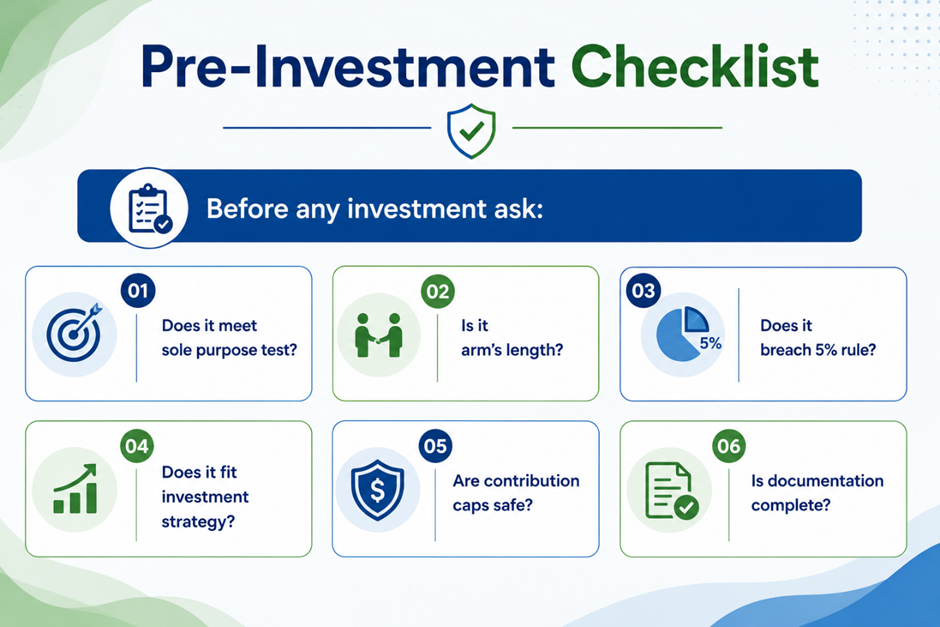
Before making any major investment decision, run through this checklist.
Have I considered the sole purpose test in relation to this investment?
Does this investment fit the fund's investment strategy, or do I need to update the strategy first?
Will this investment cause the fund to exceed the in-house asset limit, now or potentially in future?
Is the transaction on arm's length terms? Do I have documentation supporting that?
Are any contributions involved? Have I confirmed they fit within the relevant cap?
If borrowing is involved, is the structure compliant with LRBA requirements?
Have I considered the fund's liquidity, particularly in light of pension obligations?
Have I documented the decision in trustee minutes?
Have I checked with the SMSF specialist accountant or adviser before committing?
Have I taken the time to think, rather than acting under sales pressure?
If you can answer yes to each of these, the decision is more likely to be sound. If any answer is "not sure," pause and get input.
Conclusion
Being an SMSF trustee is a serious legal role with a real rulebook. Trustees who learn the rules early and revisit them as circumstances change tend to run their funds smoothly. Trustees who try to learn as they go, particularly under sales pressure or in moments of excitement, often discover the rules at the wrong moment.
You do not have to be a lawyer or an accountant to be a competent trustee. You do have to be willing to read, to ask questions, to engage with your advisers, and to take the responsibilities seriously. The rules are not impossible. They are simply numerous and interconnected, and they reward consistent attention.
The reward for doing it well is a fund that runs cleanly for decades, supports the members through accumulation and retirement, and passes through to the next generation cleanly. The cost of doing it poorly is a fund that consumes the trustees' time and money on the wrong things — fixing problems instead of building Wealth.


 Nov 12, 2026





 Please wait processing your request...