
 CA
 NZ
 UK
 US
 IND

 AU

 Share
 X (Formerly Twitter)
 Whatsapp
 Facebook
 LinkedIn
 Telegram
 Email This Article
 Copy Link
 Summarize with AI
 Chat GPT
 Perplexity

Highlights
• Many near-retirement entrepreneurs underestimate financial and operational risks.
• Overcommitting personal savings can jeopardise long-term retirement security.
• Lack of market research often leads to weak business positioning.
• Poor succession and exit planning can limit future flexibility.
Starting a business close to retirement is increasingly common, as individuals seek independence, purpose, or supplemental income. However, transitioning from a stable career to entrepreneurship at this stage brings unique challenges. With limited time to recover from setbacks, avoiding common mistakes becomes critical to protecting both financial stability and long-term goals.
AI-Powered Image
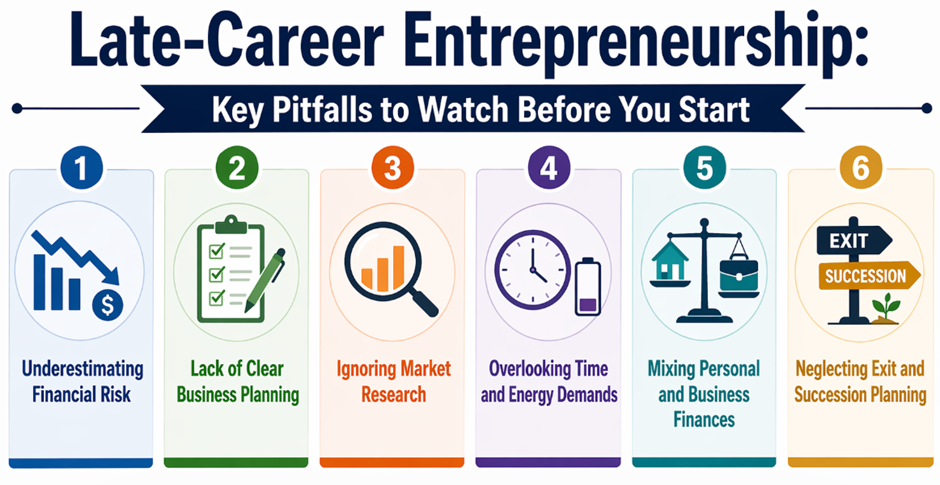
Underestimating Financial Risk
One of the most frequent errors is underestimating how much capital a business requires. Many individuals invest a large portion of their retirement savings, assuming the venture will quickly generate returns. In reality, businesses often take longer than expected to become profitable.
Without a clear financial buffer, unexpected expenses or slower revenue growth can strain personal finances. This risk is amplified when individuals rely on the business as their primary income source instead of treating it as a supplementary stream.
Lack of Clear Business Planning
A detailed business plan is often overlooked in the excitement of launching a new venture. Some assume that experience in a particular industry automatically translates into business success. However, running a business requires a broader skill set, including operations, marketing, and financial management.
Without structured planning, entrepreneurs may struggle with pricing strategies, cost control, and customer acquisition. A lack of clarity can also make it difficult to measure progress or adapt to changing market conditions.
Ignoring Market Research
Another common mistake is entering a market without sufficient research. Personal interest or prior experience may not align with current demand. Consumer preferences, competition, and pricing dynamics can shift over time, especially in rapidly evolving industries.
Failing to validate the business idea can result in offering products or services that do not meet market needs. This often leads to slow sales, increased marketing costs, and reduced profitability.
Overlooking Time and Energy Demands
Starting a business requires significant time, effort, and resilience. Many individuals underestimate the physical and mental demands involved, particularly when transitioning from a structured work environment to managing all aspects of a business independently.
Balancing business responsibilities with personal health and lifestyle goals is essential. Without realistic expectations, the workload can become overwhelming and affect overall well-being.
Mixing Personal and Business Finances
Blurring the line between personal and business finances is another frequent issue. Using personal accounts for business expenses can make it difficult to track performance and manage cash flow effectively.
This lack of separation can also complicate tax reporting and increase financial risk. Establishing clear financial boundaries from the outset helps maintain transparency and control.
Neglecting Exit and Succession Planning
Many near-retirement entrepreneurs focus on starting the business but overlook how they will eventually step away from it. Without an exit strategy, it can be challenging to realise value from the business or transition it to new ownership.
Planning ahead allows individuals to define goals, whether it involves selling the business, passing it on, or gradually reducing involvement. This ensures that the venture aligns with long-term retirement objectives.
Conclusion: Balancing Opportunity with Caution
Starting a business near retirement can be rewarding, offering both financial and personal benefits. However, the margin for error is often smaller than earlier in one’s career. Careful planning, realistic expectations, and disciplined financial management are essential to navigating this transition successfully.


 Nov 12, 2026





 Please wait processing your request...