
 CA
 NZ
 UK
 US
 IND

 AU

 Share
 X (Formerly Twitter)
 Whatsapp
 Facebook
 LinkedIn
 Telegram
 Email This Article
 Copy Link
 Summarize with AI
 Chat GPT
 Perplexity

Key Highlights
- The RBA raised the cash rate to 4.10% in March 2026, warning inflation may stay above its 2-3% target for longer than anticipated.
- Australia's CPI rose 3.8% in the year to January 2026; trimmed mean inflation was 3.4%, both above the RBA's target band.
- The US Federal Reserve's H.15 release shows the 10-year TIPS real yield at 2.01-2.13% across the final week of March 2026.
- The US 10-year nominal Treasury yielded 4.33-4.44% in the same period, placing the inflation breakeven at approximately 2.3%.
- Both Australian and US inflation-linked bonds now offer positive real yields, a meaningful shift from the record lows of 2021.
The Core Retirement Risk: Purchasing Power Erosion
The central challenge in retirement is not simply generating income. It is generating income that keeps pace with the rising cost of living. For a retiree drawing down savings over a twenty-year horizon, the cumulative effect of inflation at even modest rates is substantial. At 3.5% annual inflation, the purchasing power of a fixed income stream falls by nearly half over two decades.
This risk becomes acute when the inflation environment is uncertain. The RBA's Monetary Policy Board, in its official statement of 17 March 2026, judged that there is a material risk that inflation will remain above target for longer than previously anticipated. That assessment, from Australia's central bank, is the relevant planning context for any retiree or near-retiree evaluating their income strategy today.
What Are Inflation-Linked Government Bonds?
Inflation-linked government bonds are sovereign debt instruments whose principal and interest payments adjust in line with actual, realised inflation. In Australia, these are Treasury Indexed Bonds (TIBs), issued by the Commonwealth Government. In the United States, they are Treasury Inflation-Protected Securities (TIPS), issued by the US Department of the Treasury.
Unlike a conventional nominal bond, which pays a fixed interest rate regardless of what inflation does, an inflation-linked bond locks in a real yield: the return an investor earns above and beyond inflation, whatever that inflation turns out to be. If inflation runs at 4%, both the bond's principal value and its interest payments adjust upward. If inflation runs at 2%, they adjust to that level instead. The real return is preserved either way.
This structural feature addresses the precise risk that makes retirement planning difficult: the uncertainty of future purchasing power.
The Current Rate Environment: Why This Matters Now
For much of the period between 2020 and 2023, real yields in both Australia and the United States were deeply negative. Investors holding inflation-linked bonds were effectively paying governments for inflation protection, and the cost of that certainty was a guaranteed real loss. That period has ended.
In the United States, the Federal Reserve's official H.15 Selected Interest Rates release, the authoritative daily data source published by the Board of Governors, shows the following 10-year TIPS constant maturity real yields for the week of 23-27 March 2026:
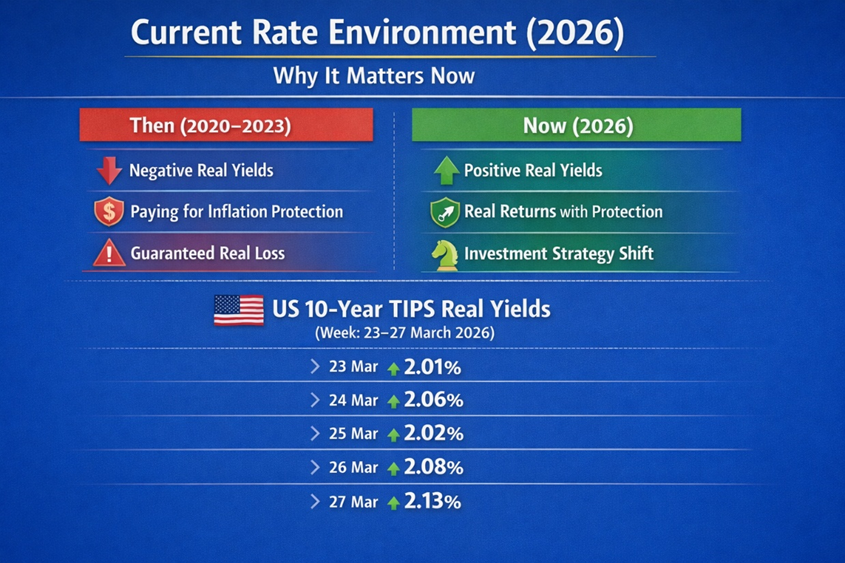
(Source: Federal Reserve H.15 Selected Interest Rates, released 30 March 2026, federalreserve.gov. EODHD/Others, Analysis: Kalkine Group)
Over the same period, the 10-year nominal Treasury constant maturity yield ranged from 4.33% to 4.44%. Yields on Treasury inflation protected securities adjusted to constant maturities are sourced from the US Treasury, as reported in the Federal Reserve's H.15 Selected Interest Rates release. The gap between the nominal yield and the real yield, approximately 2.3%, represents the market's implied inflation expectation over 10 years, known as the breakeven inflation rate. Investors who expect actual inflation to exceed that breakeven will find TIPS the more rewarding instrument over the holding period.
In Australia, the RBA Board confirmed at its March 2026 meeting that the conflict in the Middle East has resulted in sharply higher fuel prices which, if sustained, will add to inflation, and that short-term measures of inflation expectations have already risen Reserve Bank of Australia. The domestic inflation data reinforces that concern. According to the Australian Bureau of Statistics, CPI annual inflation was 3.8% in the 12 months to January 2026, with trimmed mean inflation at 3.4%, up from 3.3% in the 12 months to December 2025. The most recent release confirms a further reading: CPI annual inflation was 3.7% in the 12 months to February 2026, with trimmed mean inflation at 3.3%, unchanged from January 2026 Australian Bureau of Statistics.
Both headline and underlying inflation remain above the RBA's 2-3% target band, which the Board has explicitly linked to its decision to tighten monetary policy.
The Retirement Planning Case
For someone approaching or already in retirement, the inflation-linked bond proposition is straightforward in structure, if not always in practice.
A retiree investing in a Commonwealth Government Treasury Indexed Bond held to maturity receives a sovereign-guaranteed real return, fixed at the time of purchase, backed by the full faith and credit of the Australian government. There is no credit risk. There is no uncertainty about whether the real return will be delivered, provided the bond is held to maturity.
The parallel is instructive for US retirees considering TIPS. Yields on inflation-indexed securities at constant maturity are interpolated from the daily yield curve for Treasury inflation protected securities in the over-the-counter market, with maturities currently available at 5, 7, 10, 20, and 30 years Federal Reserve. A retiree can select a maturity that aligns with their planning horizon: a 10-year TIPS for a phased drawdown strategy, or a 30-year instrument for those seeking very long-dated inflation protection.
The RBA's own monetary policy statement provides the clearest articulation of the risk environment that makes this relevant. A longer or more severe conflict in the Middle East could put further upward pressure on global energy prices, pushing up near-term inflation and potentially increasing inflation further out if price rises become embedded in longer-term expectations. An investor holding an inflation-linked bond is indifferent to whether that scenario materialises, as the instrument adjusts to it automatically.
Important Qualifications
Inflation-linked bonds are not without risk, and this article does not constitute financial advice. Three considerations are particularly relevant for retirement planning purposes.
First, mark-to-market price risk is real. If real yields rise further after a bond is purchased, its market price will fall. This is irrelevant for investors who hold to maturity, but it creates interim paper losses for those who may need to sell before the bond matures. Retirees managing liquidity alongside capital preservation should account for this.
Second, in Australia, the indexation of a Treasury Indexed Bond's principal is generally treated as assessable income in the year it accrues, which affects after-tax returns depending on the investor's individual tax position. This is a material consideration for those in pension phase with different tax treatment applying to various components of their income.
Third, the RBA Board has noted that there are material uncertainties about the outlook for domestic economic activity and inflation and the extent to which monetary policy is restrictive. Real yields could move in either direction from current levels, affecting the relative attractiveness of the instrument compared to alternatives.


 Nov 12, 2026





 Please wait processing your request...