
 CA
 NZ
 UK
 US
 IND

 AU

 Share
 X (Formerly Twitter)
 Whatsapp
 Facebook
 LinkedIn
 Telegram
 Email This Article
 Copy Link
 Summarize with AI
 Chat GPT
 Perplexity

Superannuation continues to play a central role in how Australians prepare for retirement, and balances at age 54 attract particular attention because they sit just before the typical preservation age milestones. With markets, contribution rules and life events all shaping outcomes, understanding what an average balance looks like at this stage in 2026 can be a useful checkpoint. According to market updates and industry analysis, the picture remains uneven across cohorts, but several themes are clear and worth considering for any Australian thinking through their retirement trajectory.
What the average balance actually represents
Headline average balances are useful as a high-level signal, but they can mask significant variation. A small number of high-balance accounts can pull averages upward, which is why median figures are sometimes more representative of the typical Australian's position. Both figures are shaped by gender gaps, career patterns, self-employment, and time spent out of the workforce.
Industry research bodies, including the Association of Superannuation Funds of Australia, regularly publish balance snapshots by age. While the exact numbers move from year to year, the broad structure remains consistent: balances rise relatively quickly between the late 30s and the late 50s as compounding takes hold and incomes peak. By age 54, most full-time workers have experienced multiple market cycles.
Comparing your own balance to a national average is therefore less informative than comparing it to your projected income needs in retirement. Two members with the same balance may have very different outcomes depending on housing costs, partner income, expected longevity and tax position. Industry calculators increasingly emphasise projected income rather than balances alone, and that framing is gaining traction.
Context: why age 54 is a watch-point
Age 54 is close to but still short of the preservation age window that applies to most Australians today. It is a useful planning checkpoint because there is still time to make material changes - whether through additional concessional contributions, salary sacrifice, downsizer plans, Debt reduction or asset allocation adjustments. Investors are watching the shape of their projected retirement income rather than just the absolute balance, as drawdown strategies are equally important.
Many Australians at this age are also weighing competing financial priorities, including supporting children through education, paying down a Mortgage, and possibly providing care for older parents. These competing demands can affect how much can be directed toward super in the run-up to retirement.
A practical check at age 54 often involves three steps: consolidate any forgotten accounts, review the Investment option, and confirm beneficiary nominations. Each takes only a short time but can have a measurable impact over the years that follow. According to market updates, fund-level reporting has made the consolidation step easier than it once was, with most funds offering streamlined transfer tools.
How balances are tracking in 2026
Although exact figures vary by report, the general direction in recent years has been upward, supported by a combination of higher Superannuation Guarantee contributions, sustained Equity market exposure in default Options, and the maturation of long-tenured members. The Superannuation Guarantee rate has increased gradually under legislated steps, lifting compulsory employer contributions as a share of ordinary time Earnings.
Market returns have also played a role. Default MySuper balanced options have generally produced positive long-term returns, although individual years have varied. According to industry commentary, the diversified mix of growth and defensive Assets in these products has helped smooth returns over the long run.
Behavioural factors continue to shape the picture as well. Members who engage with their account at least annually tend to make better-informed decisions about contributions, consolidation and investment options. Funds have invested in digital tools and education resources to encourage that engagement, which is gradually reflecting in median outcomes.
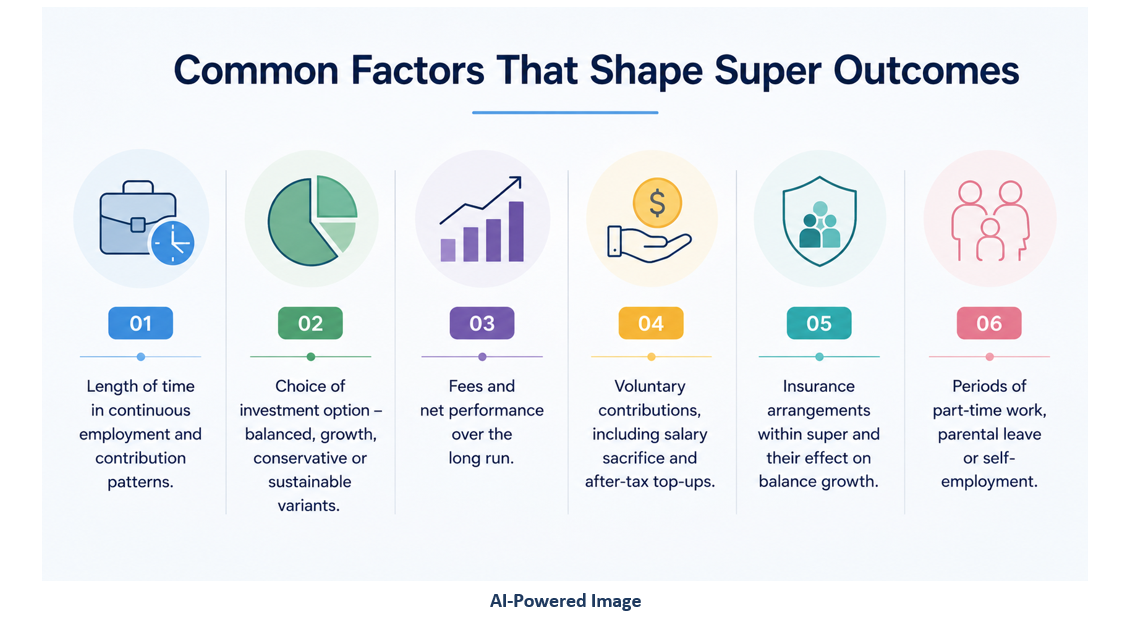
Why balance trends matter now
With cost-of-living pressures and shifting interest-rate cycles, the question of how much is enough has moved up the agenda. Many Australians at age 54 are using available calculators to estimate how their balance might convert into retirement income, allowing for Inflation, longevity and possible Age Pension entitlements.
Industry guidance often points to the ASFA Retirement Standard as a reference for comfortable and modest retirement budgets. Those benchmarks are updated regularly and provide a target range for projected income rather than an absolute rule. Comparing a current trajectory to these benchmarks can highlight whether additional steps may be warranted.
The retirement income covenant has reinforced the focus on income outcomes. Trustees are required to develop strategies that help members move from accumulation toward sustainable income streams. That framework matters at age 54 because the decisions made now influence the products and pathways that will be available later.
Implications for planning
Even small changes during the years immediately before retirement can have a compounded effect. Reviewing the investment option, verifying that consolidations have been completed where appropriate, and checking whether insurance cover remains appropriate can all be part of the conversation. For some, paying down high-interest debt may take precedence over additional contributions, while others may benefit from accessing the carry-forward concessional cap rules where eligible.
Understanding sequencing risk - the impact of a market downturn early in retirement - is another consideration that often shapes asset allocation decisions in the lead-up. Many advisers discuss a graduated reduction in growth exposure rather than an abrupt shift to defensive assets.
Estate and beneficiary planning is another area that often gets revisited at this stage. Updating binding beneficiary nominations, reviewing wills, and ensuring power-of-attorney documents are current can save administrative effort later. These steps are not just for high-balance members - they apply to most adult Australians with super accounts.
Risks and counterpoints
Headline balance comparisons can encourage benchmarking that does not match an individual's circumstances. Two Australians with the same balance at age 54 may have very different incomes, expense profiles, debts and family situations. Average figures do not account for those differences. According to industry commentary, the gap between average and median balances continues to draw policy attention, especially in relation to gender outcomes.
There are also risks tied to the assumptions used in retirement calculators. Long-run return expectations, inflation and longevity assumptions can change, and small revisions to those inputs can move projected outcomes meaningfully. Treating calculator outputs as scenario analyses rather than forecasts is an important framing.
Policy risk is another consideration. Concessional and non-concessional caps, the treatment of large balances, and rules around access can change with legislation. Members who plan strictly around current settings without considering possible adjustments may find their plans need updating later. Watching for legislated transitions is part of staying on track.
What Australians may watch next
Investors are watching the legislative settings around concessional and non-concessional caps, the Superannuation Guarantee rate and any further changes to the Division 296 tax settings on large balances. Market direction and inflation prints will continue to influence the value of accumulation accounts. Superannuation funds are also rolling out tools that focus on projected retirement income rather than balances alone.
- Annual member statements and fund-level performance reports.
- Updates to the ASFA Retirement Standard income benchmarks.
- Contribution caps and any legislative changes affecting timing.
- Investment option suitability as the time horizon shortens.
- Insurance cover within super and its cost relative to need.
- Beneficiary nominations and broader estate planning steps.
Balanced conclusion
The average super balance at age 54 is a useful benchmark but should never be treated as a target. Each Australian's circumstances are unique, and the more meaningful exercise is to translate the balance into projected income and compare that with individual goals. With several years still to retirement for most, the years around age 54 can be productive ones for fine-tuning contributions, fees, asset allocation and insurance settings. Engaging with a fund's tools or with a licensed adviser can help convert headline data into a clearer plan.
Closing the gap with targeted strategies
For Australians who feel they are tracking below where they would like to be at age 54, a number of strategies are frequently discussed with advisers. Catch-up concessional contributions can use unused cap space from prior years for members with eligible total super balances, allowing larger tax-effective contributions in a single year. Salary sacrifice and personal deductible contributions can lift compulsory employer contributions in a controlled way. Spouse contributions, contribution splitting, and the downsizer contribution rules can each play a role depending on circumstances. Each strategy comes with eligibility and timing considerations that Warrant individualised review.
Investment-side adjustments can be just as consequential. Reviewing whether the chosen option aligns with the time horizon, fees, and Risk tolerance is a standard checkpoint. Some members move from a default growth-tilted balanced option toward a slightly more conservative profile as they approach retirement, while others adopt a glide path that transitions gradually. The right approach depends on household income sources, expected longevity, and any non-super Wealth that contributes to overall financial resilience.
From accumulation to retirement income
The transition from accumulation to retirement income is increasingly recognised as one of the most important decisions in the super journey. Account-based pensions remain the most common vehicle, but lifetime income products and innovative Annuity-style options have grown in availability under the retirement income covenant. Each product has different drawdown rules, tax treatment and longevity protection features. Members are encouraged to consider income outcomes, not just balance outcomes, as the primary measure of retirement readiness.
The interaction with the Age Pension is also crucial. Even members with relatively healthy super balances may receive part-pension entitlements at certain points in retirement, and the means tests interact in nuanced ways with home ownership, financial assets and income streams. Modelling the combined picture - super, pension, other savings - produces a more realistic projection than viewing super in isolation. Many funds now provide retirement calculators that incorporate this combined view.
Frequently Asked Questions
What is the average super balance at age 54 in Australia?
The exact figure varies by report and methodology, but balances tend to sit in a wide range, with significant differences between men and women and between full-time and part-time workers. Industry sources such as ASFA publish updated benchmarks each year, and most funds also publish age-band data in member communications.
Why is age 54 considered an important superannuation milestone?
Age 54 sits close to common preservation-age windows and gives members several years to fine-tune contributions, asset allocation and other settings before retirement, while still benefiting from compounding. It is far enough from retirement that changes can have meaningful effect.
Is the average balance the same as the median?
No. The average is pulled higher by a small number of large balances, while the median represents the middle point. Both are useful, but the median is often more representative of the typical member, particularly in age bands where balance dispersion is wide.
What can Australians do if they feel behind on super?
Options can include reviewing fees and investment options, considering salary sacrifice or carry-forward concessional contributions where eligible, consolidating accounts where appropriate, and using retirement income calculators. Specific decisions are best discussed with a licensed adviser who understands the member's full circumstances.
Disclaimer
This article is for general information only and does not constitute financial, legal, or investment advice.


 Nov 12, 2026





 Please wait processing your request...