
 CA
 NZ
 UK
 US
 IND

 AU

 Share
 X (Formerly Twitter)
 Whatsapp
 Facebook
 LinkedIn
 Telegram
 Email This Article
 Copy Link
 Summarize with AI
 Chat GPT
 Perplexity

Key Highlights:
- Cash Flow before everything: a 3 to 6 month buffer is non-Negotiable before deploying Capital into any growth asset
- Superannuation is underused: concessional contributions taxed at 15% make it Australia's most powerful Wealth-building vehicle
- Debt is not the enemy: high-cost consumptive Debt (cards, BNPL, personal loans) is, clearing it delivers a guaranteed, risk-free return
- Behaviour beats income: automating savings before discretionary spending is the single most effective Wealth habit available
In a year defined by rate uncertainty, persistent Inflation and shifting household balance sheets, sustainable Wealth creation demands more than passive saving. It requires intentional financial strategy.
2026 marks a structural reset in household finance across Australia. Elevated interest rates, high by the standards of the past decade, continue to reshape the Economics of borrowing, saving and investing. Inflation, while moderating, still exerts pressure on everyday expenses, and wage growth has not kept pace with the full force of rising costs for many households.
In this environment, the old formula of "earn, save, repeat" is no longer sufficient. Building lasting Wealth now demands deliberate decisions about Cash Flow, Debt, asset allocation and behaviour.
"Wealth building in 2026 is less about timing markets and more about structural financial positioning."
Why 2026 Demands Financial Discipline
The macroeconomic backdrop has shifted materially. The RBA rate cycle remains complex, Australian property markets face affordability constraints, labour market fragility is emerging in pockets, and global geopolitical tensions are introducing Volatility across Supply chains and Equity markets. Personal Finance decisions are increasingly macro-sensitive. Households that ignore this context do so at their own risk.
Below are five rules designed to help Australian households navigate this landscape with clarity and discipline.
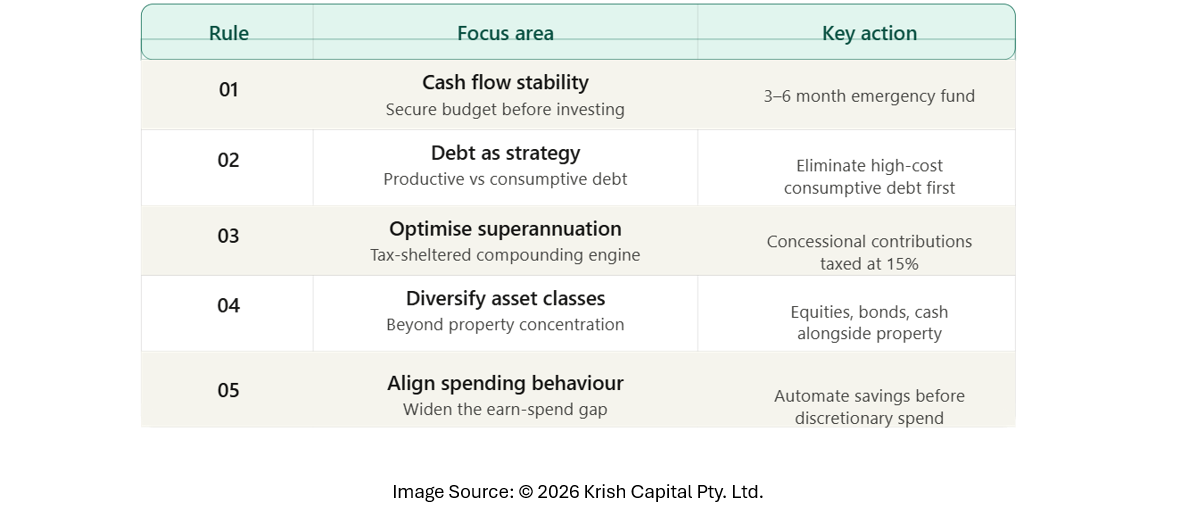
Rule 1: Prioritise Cash Flow Before Investment
Before deploying Capital into growth Assets, secure stable monthly Cash Flow. With mortgages resetting at higher rates, budget pressure is real and underestimated. An income disruption without a cash buffer can force asset sales at the worst possible time.
- Audit fixed versus variable Loan exposure
- Maintain 3–6 months of expenses in an accessible Savings Account
- Map Debt repayments as a share of after-tax income before investing further
Strategic Insight: Cash Flow stability is the foundation of all Capital allocation, not a constraint on it.
Rule 2: Treat Debt as a Strategic Lever
Not all Debt is equal. The key question is whether your borrowing cost is justified by expected returns. At current Australian Mortgage rates, that calculation is harder than it used to be.
- Productive Debt (Investment-linked) can build Wealth if returns exceed the cost of funds
- Consumptive Debt including Credit cards, BNPL and personal loans delivers no Capital return; eliminating it is one of the highest-returning decisions available
- Review your Mortgage rate against the current market; lender inertia is costly
Strategic Insight: Every dollar of high-cost consumptive Debt retired is a guaranteed, risk-free return at that Interest Rate.
Rule 3: Actively Optimise Your Superannuation
Super remains Australia's most tax-efficient Wealth vehicle, yet most households treat it passively. Concessional contributions are taxed at just 15%, well below most marginal rates, and multi-decade compounding creates advantages that are difficult to replicate elsewhere.
- Explore salary sacrifice to maximise concessional contributions
- Review your Investment option as default balanced funds may not suit your time horizon
- Investigate carry-forward concessional cap rules if you have had lower-balance years
Strategic Insight: Super is not a retirement account. It is a tax-sheltered compounding engine that rewards active engagement.
Rule 4: Diversify Beyond Property
Australian household Wealth is heavily concentrated in residential property. While property has long-term merit, overexposure to a single Asset Class creates real concentration risk, especially as affordability pressures and rate headwinds persist.
- Equities (ASX and global) offer long-run growth with superior Liquidity
- Fixed income including bonds and term deposits has returned to relevance after years of near-zero yields
- Cash in high-interest accounts now offers meaningful real returns and preserves optionality
Strategic Insight: Diversification is not about owning more things. It is about owning Assets that behave differently across economic cycles.
Rule 5: Close the Gap Between Spending and Saving
Behavioural finance research is consistent: Wealth accumulation is constrained more by spending habits than income levels. Lifestyle Inflation, where spending rises in line with income, is the silent destroyer of Wealth-building momentum.
- Automate Investment contributions before discretionary spending decisions are made
- Treat your budget as a Capital allocation exercise: every dollar spent is a dollar not compounding
- Keep Investment accounts structurally separate from spending accounts; friction is a feature
Strategic Insight: The most powerful financial tool is the deliberate gap between what you earn and what you spend.
Risk Considerations
Even well-constructed financial strategies carry inherent risks. 2026 presents several that Australian households should keep front of mind:
- Market Volatility: Price swings can compress returns and test long-term resolve, particularly for leveraged investors
- Interest Rate Shocks: Unexpected RBA movements can strain variable-rate borrowers rapidly; high Debt-to-income ratios increase exposure
- Policy and Tax Changes: Super rules, negative gearing and CGT settings remain subject to reform; build flexibility into your plans
- Liquidity Constraints: Too much Capital in Illiquid Assets can force poor decisions under pressure; liquid reserves are strategically essential
Conclusion
Wealth building in 2026 is an active discipline, not a passive outcome. The five rules above don't require sophisticated instruments or exceptional income. They require discipline, long-term thinking and honest alignment between daily behaviour and financial goals. Markets will remain uncertain. What remains within your control is the quality of your decisions.
FAQs:
- How much should I keep in an emergency fund?
Most financial planners recommend 3 to 6 months of essential expenses in a high-interest Savings Account, lean toward 6 months if your income is variable or contract-based.
- What is the easiest way to reduce tax through Superannuation?
Salary sacrificing into super means contributions are taxed at 15% rather than your marginal rate, for most Australians, that is a meaningful saving. Check current contribution caps and speak with a licensed adviser.
- Is property still worth investing in during 2026?
Property has long-term merit, but Australian households are typically overexposed to it. Treating it as one part of a diversified portfolio, alongside equities, bonds and cash, reduces concentration risk significantly.
- Why does lifestyle Inflation matter so much?
When spending rises in line with income, the earn-spend gap stays flat regardless of salary growth. Closing and protecting that gap through automation is where real Wealth accumulation happens.


 Nov 09, 2026





 Please wait processing your request...