
 CA
 NZ
 UK
 US
 IND

 AU

 Share
 X (Formerly Twitter)
 Whatsapp
 Facebook
 LinkedIn
 Telegram
 Email This Article
 Copy Link
 Summarize with AI
 Chat GPT
 Perplexity
Highlights
- Stagflation describes a period of high inflation combined with weak economic growth.
- The term was first used by Iain Macleod in 1965 to describe economic strain.
- Rising global oil prices have renewed concerns about stagflation risks.
- Central banks face policy challenges when inflation and slow growth occur together.
- Current economic conditions differ from the severe stagflation seen in the 1970s.
Stagflation is one of the more challenging economic environments to navigate. It occurs when inflation remains persistently high while economic growth slows or stagnates. Unlike typical economic cycles, where inflation and growth move in opposite directions, stagflation represents a rare overlap of rising prices and weakening economic momentum.
The concept gained prominence in the 1960s when Iain Macleod described it as the “worst of both worlds.” That description still holds relevance today, as economies grapple with balancing price stability and growth.
Why Stagflation Is Back in Focus
In recent times, stagflation has re-entered global discussions due to a combination of rising energy prices and persistent inflation. Disruptions to oil supply chains, particularly linked to geopolitical tensions involving the US, Israel, and Iran, have pushed global oil prices significantly higher.
As fuel costs increase, they ripple through the economy. Higher petrol, diesel, and jet fuel prices raise transportation and logistics costs, which then feed into the prices of goods and services. This broad-based price pressure contributes to sustained inflation levels.
At the same time, economic growth faces pressure. Higher costs can reduce consumer spending and business investment, creating conditions where growth begins to slow even as inflation remains elevated.
The Policy Dilemma: Why It’s Hard to Fix
Stagflation presents a unique challenge for central banks. Typically, policymakers rely on interest rates to manage the economy. When inflation is high, they raise rates to reduce spending. When growth slows, they cut rates to stimulate activity.
However, during stagflation, these tools can conflict. Raising interest rates may help control inflation but can further slow economic growth and increase unemployment. On the other hand, lowering rates can support growth but risks prolonging inflation.
This policy trade-off makes stagflation particularly difficult to manage, as each solution can worsen another part of the problem.
How Today’s Situation Is Different
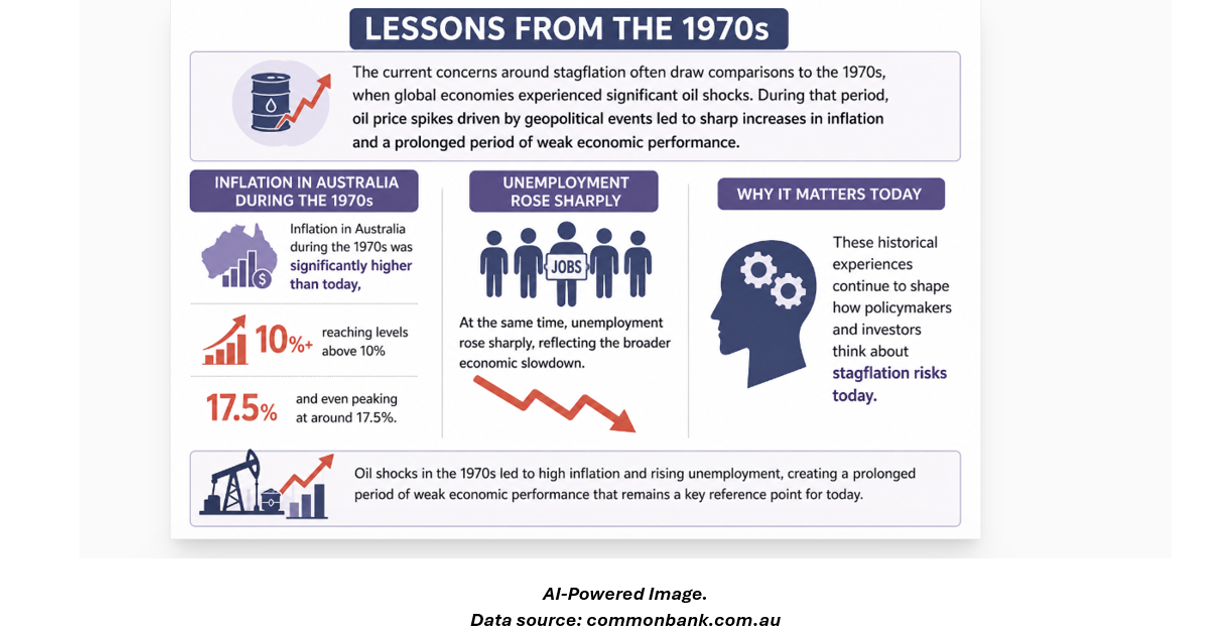
Despite similarities, the current economic environment differs in several important ways. Inflation, while elevated, remains considerably lower than the levels seen in the 1970s. Additionally, unemployment rates are relatively stable, and economic growth, though modest, continues.
Another key difference lies in household financial resilience. Many households are entering this period with stronger financial buffers, including stable incomes and improved savings positions. This provides some cushion against rising costs.
Moreover, central banks today operate with more refined policy frameworks and tools, allowing for more targeted responses to inflation and growth challenges.
What Could Happen Next?
The trajectory of stagflation risks will largely depend on how current pressures evolve. If oil prices stabilise and supply chains normalise, the impact of higher energy costs may remain contained. In such a scenario, inflation could ease without significantly disrupting economic growth.
However, if elevated costs persist and begin to weigh more heavily on spending and investment, the risk of stagflation could increase. The balance between inflation control and growth support will remain a key focus for policymakers.
For now, while concerns are valid, the economic backdrop still reflects ongoing growth and a stable labour market, suggesting that stagflation remains a risk rather than a certainty.
FAQs:
What is stagflation in simple terms?
Stagflation is when an economy experiences high inflation alongside slow or stagnant economic growth.
Why is stagflation considered problematic?
It creates a difficult situation where efforts to control inflation can harm growth, and measures to boost growth can worsen inflation.
How is today different from the 1970s stagflation?
Inflation and unemployment levels today are lower, and households generally have stronger financial positions compared to the 1970s.
Can stagflation be avoided?
It depends on factors like energy prices, supply chains, and policy responses. Stabilisation in these areas can reduce the likelihood of stagflation.


 Nov 09, 2026





 Please wait processing your request...