
 CA
 NZ
 UK
 US
 IND

 AU

 Share
 X (Formerly Twitter)
 Whatsapp
 Facebook
 LinkedIn
 Telegram
 Email This Article
 Copy Link
 Summarize with AI
 Chat GPT
 Perplexity

Highlights
- The RBA’s next Interest Rate decision could materially influence ASX stock valuations, Mortgage repayments, and household spending trends.
- Inflation indicators have moderated overall, although services inflation has remained persistent and closely watched by policymakers.
- Labour market conditions have softened gradually, with Unemployment rising and employment growth slowing from earlier highs.
- Lower interest rates could support sectors such as property, infrastructure, consumer discretionary, and growth-focused ASX stocks.
- Mortgage holders could see meaningful repayment relief if the RBA continues its gradual easing cycle over coming quarters.
The Reserve Bank of Australia's interest rate decisions have a more direct and tangible impact on Australian households and the ASX than almost any other policy variable. As the Central Bank navigates the complex 2026 environment of moderating but still elevated inflation, slowing growth, and a labour market showing signs of softening, every monthly Board meeting and every speech by the Governor is parsed for clues about the path of the cash rate. For ASX stocks investors and the millions of Australian mortgage holders, the next interest rate move from the RBA could materially shift the outlook for share prices, household budgets, and the broader Australian stock market trajectory.
Why This Topic Matters Now
Interest rates influence virtually every financial decision in the Australian economy. For mortgage holders, even small changes in the cash rate translate into meaningful monthly payment changes given the size of household Debt loads built up during the era of cheap money. For ASX stocks, interest rates affect discount rates applied to future cash flows, Cost of Capital for businesses, and the relative attractiveness of equities versus fixed income.
The 2026 environment makes the RBA's next move particularly consequential. After the aggressive tightening cycle that took the cash rate from near-zero in 2022 to the eventual peak, the RBA has begun a measured easing cycle. The question now is the pace and depth of additional cuts, and whether economic conditions Warrant accelerated easing or prudent patience. The market's expectation curve has shifted multiple times based on inflation prints and economic data, with each shift moving share prices and bond yields.
For Australian shares investors, understanding the interest rate dynamic is essential for asset allocation, sector positioning, and individual stock selection. For mortgage holders, the rate path determines budget pressure for years ahead.
Macro Background
The Reserve Bank of Australia's Monetary Policy framework targets inflation in the 2–3% range over the medium term while supporting Full Employment. The cash rate is the primary tool, with the RBA Board meeting monthly to make rate decisions and provide forward guidance.
The 2022–2023 tightening cycle was one of the most aggressive in the RBA's history, taking the cash rate from 0.10% to 4.35% over approximately 18 months. This was a response to the post-Pandemic inflation surge driven by Supply chain disruption, energy price shocks, fiscal stimulus, and Demand-supply imbalances. The pace of tightening was rapid by historical standards, and the lagged effects continued to flow through the economy long after the rate hikes concluded.
The peak in cash rates was followed by an extended hold period as the RBA assessed whether inflation was returning sustainably to target. Cuts began once the central bank gained sufficient confidence in the inflation trajectory, but the pace has been measured. Each cut has been accompanied by emphasis on data dependence and the need for ongoing assessment.
The Australian economy in 2026 reflects the cumulative impact of this policy cycle. Household consumption has been weak as mortgage payments absorb increased shares of Disposable Income. Business Investment has been mixed, with some sectors investing strongly in AI and energy transition while others have pulled back. The labour market has remained reasonably resilient but has begun showing some softening, with unemployment edging higher from its post-pandemic lows.
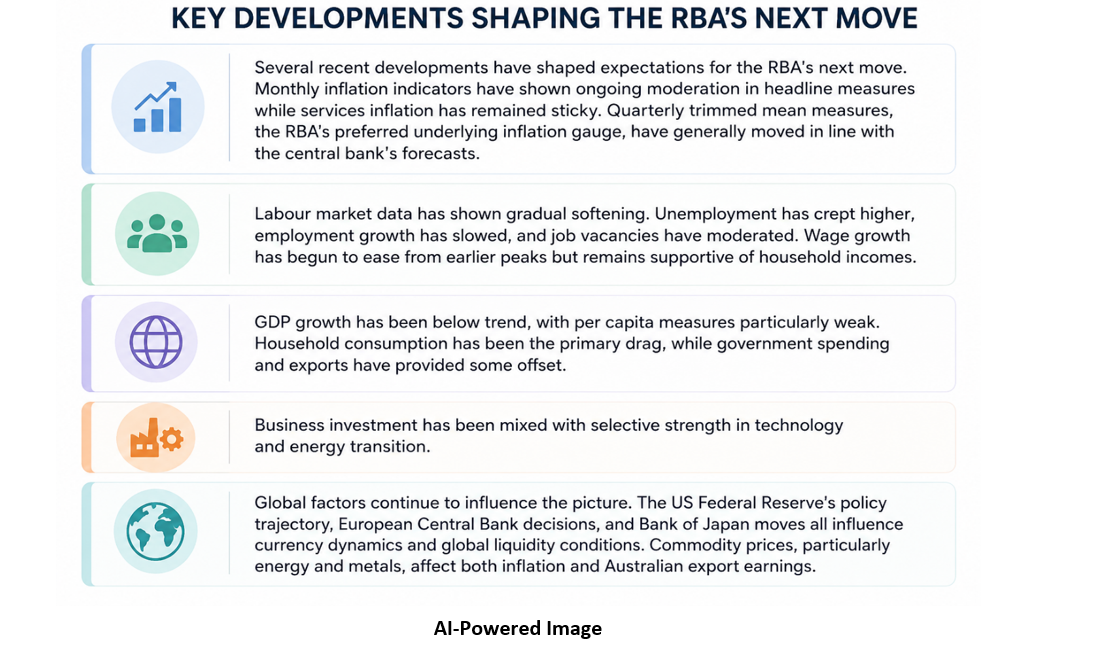
The RBA's forward guidance has emphasised data dependence rather than committing to a specific easing path. Governor speeches and statement language have been carefully calibrated to maintain flexibility while providing some directional guidance to markets.
Financial and Valuation Considerations
Interest rate movements have multiple channels of impact on ASX stocks. The discount rate channel affects valuations across all asset classes, with longer-duration Assets including Growth Stocks and infrastructure most sensitive. Lower rates support higher valuations, all else equal, by reducing the discount applied to future cash flows.
The Earnings channel affects companies through multiple paths. Lower rates reduce financing costs for indebted companies, supporting earnings. Lower rates can stimulate consumer demand, supporting consumer-facing businesses. Lower rates support property valuations, benefiting REITs and developers. However, lower rates compress net interest margins for banks and insurers.
The currency channel matters for international earners and exporters. Lower rates typically weaken the Australian dollar, supporting earnings translated from foreign operations and improving competitive position for exporters. ASX healthcare stocks like CSL and ResMed, ASX consumer stocks with significant foreign operations, and resource exporters all benefit from currency tailwinds.
Sector responses differ. Banks benefit from lower funding costs but face Margin pressure. Property and infrastructure businesses benefit from valuation tailwinds. Consumer discretionary stocks benefit from improved household spending capacity. Resource stocks benefit from currency support and improved global growth conditions. Growth stocks benefit from valuation re-rating but are sensitive to growth disappointments.
For mortgage holders, the impact is more direct. A 25 basis point cut on a $600,000 mortgage saves roughly $90 per month in interest payments. Cumulative cuts of 100 basis points or more meaningfully improve household budgets. The relief flows through to consumer spending, supporting consumer-facing ASX stocks.
Risks and Counterarguments
The expectation of continued rate cuts faces several risks. Inflation reacceleration would force the RBA to pause or even reverse course. A renewed energy price shock, persistent services inflation, or wage-price dynamics could all delay further easing. Markets that have priced in continued cuts could see significant repricing if inflation surprises to the upside.
Global factors could also delay easing. If the US Federal Reserve maintains tighter policy than expected or if global financial conditions tighten unexpectedly, the RBA may be reluctant to ease aggressively. Currency considerations matter, with significant currency weakness from rate divergence creating its own inflation pressures.
The path of cuts may also be slower than markets expect even without major surprises. The RBA has consistently emphasised gradualism and data dependence. Rate cuts will likely be measured rather than aggressive unless economic conditions deteriorate significantly.
The flip side risk is that the RBA could be forced to cut more aggressively if economic conditions worsen materially. A significant deterioration in the labour market, a sharp slowdown in growth, or a financial stability event could all prompt accelerated easing. While this would support Equity valuations through lower discount rates, it would reflect underlying economic weakness that would pressure earnings.
For mortgage holders, the risk is that rate relief comes more slowly than household budgets need. Existing financial pressure could continue affecting consumer spending and household financial stress for some time.
What Investors Should Watch Next
ASX investors monitoring the RBA outlook should focus on several key indicators. Monthly inflation indicators provide early read on price dynamics. Quarterly CPI data, particularly the trimmed mean and weighted median measures, provide the most reliable inflation signal. Any sustained surprise in either direction would shift expectations.
Labour market data including the unemployment rate, employment growth, and wage measures all influence the RBA's assessment. The Wage Price index quarterly release is particularly important.
GDP and consumption data provide the underlying growth context. Retail sales, household consumption indicators, and broader business activity measures all matter.
RBA communications including the post-meeting statement, Statement on Monetary Policy, and Governor speeches provide direct guidance on policy thinking. Any shift in language or emphasis can signal policy direction.
Global developments including Federal Reserve decisions, European inflation data, and Chinese economic performance all influence the broader environment. Currency movements, particularly the AUD/USD, both reflect and influence policy expectations.
Outlook
The outlook for the RBA cash rate path remains finely balanced but tilted toward continued gradual easing. Underlying inflation appears to be returning to target sustainably. Labour market softening removes some upward pressure on wages and prices. Economic growth below trend supports the case for continued accommodation.
For ASX stocks, continued gradual rate cuts would generally be supportive. Lower discount rates would support valuations across most sectors. Currency support would benefit international earners and exporters. Improved consumer spending would benefit retail and discretionary names. However, banks would face margin pressure that could partially offset benefits from improving Credit conditions.
For mortgage holders, continued cuts would provide gradually improving budget relief. The cumulative impact of 50–100 basis points of additional easing over coming quarters would be meaningful for household financial stress. This should support consumer spending recovery and benefit consumer-facing Australian shares.
The pace and timing remain uncertain. Markets will continue to recalibrate expectations based on each data print and RBA communication. Volatility around monthly meeting dates and major data releases is likely to continue. Investors should expect periodic shifts in expectations rather than a smooth, predictable path.
For long-term investors, the rate cycle is one important Factor among several. Quality, valuation, and individual business fundamentals remain the primary drivers of returns over multi-year periods. Building portfolios that can navigate various rate scenarios, rather than betting heavily on a single path, remains prudent positioning.
The RBA's next move will likely be one of many over the coming quarters. Each will influence ASX stocks and mortgage holders in slightly different ways, but the cumulative impact of the easing cycle, if it continues, should provide meaningful support to the Australian economy and stock market over time.
FAQs:
Q: Why are RBA interest rate decisions important for ASX investors?
A: Interest rate changes affect company valuations, borrowing costs, consumer demand, and investor sentiment across the Australian share market.
Q: Which ASX sectors typically benefit from lower interest rates?
A: Property, infrastructure, consumer discretionary, exporters, and growth-oriented technology stocks often benefit from lower rates and improved Liquidity conditions.
Q: How could further RBA rate cuts affect mortgage holders?
A: Lower rates can reduce monthly mortgage repayments, improve household Cash Flow, and potentially support consumer spending.
Q: What risks could delay additional RBA rate cuts?
A: Persistent inflation, higher energy prices, global central bank tightening, or stronger-than-expected wage growth could slow or delay further easing.


 Nov 09, 2026





 Please wait processing your request...