
 CA
 NZ
 UK
 US
 IND

 AU

 Share
 X (Formerly Twitter)
 Whatsapp
 Facebook
 LinkedIn
 Telegram
 Email This Article
 Copy Link
 Summarize with AI
 Chat GPT
 Perplexity

Highlights
- Following the latest Budget, many Australian investors appear to be reassessing how much of their Wealth should sit in residential property.
- Diversification themes are gaining traction, with shares, Exchange-traded funds, Superannuation contributions and listed property trusts featuring more prominently in investor discussions.
- Liquidity, concentration risk and rising Holding Costs are key reasons cited for the rethink, rather than any single Budget measure.
- Commercial property, infrastructure and alternative Assets are being explored as ways to retain property-like exposure without the burdens of direct residential ownership.
- Generational shifts are influencing strategy, with younger Australians often priced out of housing and older investors weighing when and how to crystallise gains.
- The shift may be gradual rather than abrupt, with bricks and mortar still central to most household wealth in Australia.
- This article is general information only and does not constitute financial advice.
The federal Budget has prompted a broader conversation among Australian investors about whether the long run of residential property dominance in household portfolios is entering a new phase. Rather than focusing narrowly on whether house prices will rise or fall in the short term, more investors appear to be asking a bigger question: how should wealth be organised when bricks and mortar carry heavier costs, tighter lending conditions and a less certain policy backdrop?
In the wake of the Budget, financial advisers, accountants and online investing communities have reported a noticeable uptick in discussions about diversification. Many of those conversations are not about abandoning property altogether. Instead, they centre on whether the share of net wealth devoted to direct residential property should be trimmed in favour of other asset classes.
The shift is showing up in several ways. Some investors are accelerating voluntary superannuation contributions, taking advantage of concessional caps and the long-term tax treatment of super. Others are increasing allocations to Australian and global share funds, often through exchange-traded funds that offer low-cost, diversified exposure. A smaller but growing cohort is exploring listed property trusts, commercial property syndicates and alternatives such as infrastructure and private Credit.
None of these moves are entirely new. Diversification has been a staple of financial planning for decades. What appears to have changed is the intensity of interest, and the willingness of long-time property enthusiasts to entertain a more balanced approach. For an investor culture that has historically prized residential property above almost all else, that is a meaningful evolution.
Mortgage Brokers, accountants and planners have also reported a subtle change in client questions. Instead of asking when to buy the next property, more clients are asking how to organise existing wealth more efficiently. That includes reviewing ownership structures, considering whether to pay down Investment Debt rather than expand it, and weighing the merits of holding cash and liquid investments through a period of uncertainty.
Why It Matters
 AI-Powered Image
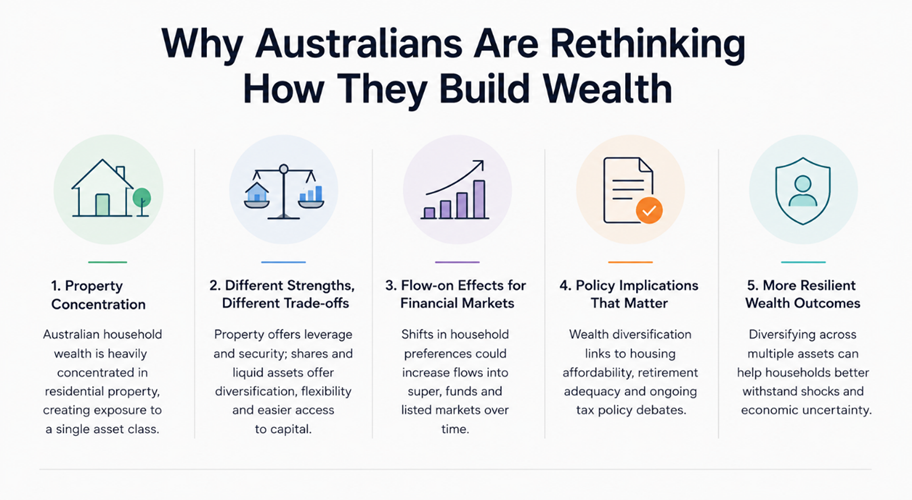
Australia's household wealth profile has long been skewed towards residential property. That concentration has helped many families build substantial net worth as prices rose over decades, but it has also left them exposed to a single Asset Class. A genuine Rebalancing in how wealth is held would have significant implications for households, financial markets and the broader economy.
For individual investors, the rethink matters because the trade-offs between property and other assets are not trivial. Property offers tangibility, Leverage and, for many, an emotional sense of security. Shares and other Liquid assets offer easier access to Capital, broader diversification and the ability to scale exposure up or down without selling an entire asset. Each approach has strengths and weaknesses, and the right mix varies by household.
For the financial system, a shift in investor preferences could influence flows into superannuation, managed funds and listed markets. Even modest reallocations across millions of households add up. Fund managers, ETF providers and listed property vehicles may see changing Demand patterns as a result.
For policymakers, the conversation feeds into longer-running debates about housing affordability, retirement adequacy and the role of tax concessions. If more Australians choose to build wealth outside residential property, pressure on housing as an investment vehicle could ease over time, though such shifts typically play out over years rather than months.
There is also a behavioural dimension. Households that diversify away from heavy reliance on a single asset class can find themselves better placed to weather shocks, whether those shocks come from interest rates, employment changes or unexpected expenses. A wealth strategy that depends on continually rising house prices is more fragile than one that draws on multiple sources of return. For many investors, the Budget has prompted a useful moment to test how resilient their current arrangements really are.
Market, Business or Consumer Context
The current rethink is taking place against a particular market backdrop. Australian share markets have continued to attract retail interest, helped by the growth of low-cost ETFs and the popularity of online brokerage platforms. Younger investors, in particular, have been active in listed markets, often because direct property ownership feels out of reach. For these investors, the Budget has simply reinforced a path they were already on.
Superannuation remains a central pillar of long-term wealth building. With concessional contributions taxed at a lower rate than most marginal income tax rates, and investment Earnings within super taxed concessionally, the system offers a structurally attractive home for retirement savings. Many advisers have long argued that investors with excess Cash Flow should consider whether topping up super offers better Risk-adjusted outcomes than acquiring another residential property.
Listed property trusts, or A-REITs, provide another avenue. These vehicles invest in commercial, industrial, retail and, increasingly, residential assets, and trade on the ASX like ordinary shares. They offer property-like income exposure with daily liquidity, though their share prices can be more volatile than direct property values. For investors who want to retain a property tilt without taking on more direct landlording, A-REITs are part of the conversation.
Commercial property syndicates and unlisted property funds offer yet another option, typically with higher minimum investments and lower liquidity. These vehicles have grown in popularity among self-managed super funds seeking Yield. Industrial property, in particular, has attracted attention in recent years on the back of structural growth in logistics and E-commerce, though conditions vary by sub-sector and location.
Beyond property and shares, alternative assets such as infrastructure, private credit, agriculture and global thematic ETFs have entered more mainstream portfolios. None of these are without risk, and many carry liquidity or complexity considerations that direct residential property does not. But their growing visibility reflects a broader shift in how Australian investors think about building and protecting wealth.
Consumer sentiment surveys, while imperfect, suggest a more cautious mood among investors. Confidence in property as the best place for savings has eased from peaks seen in earlier years, while interest in shares and super has held up. The Budget may be accelerating, rather than initiating, a trend that has been building for some time.
Key Companies or Sectors in Focus
Several parts of the listed market are directly relevant to the post-Budget rethink. ASX-listed real estate investment trusts span office, retail, industrial, healthcare and residential development assets. Their performance can diverge sharply from the residential market, and they offer a way to express views on specific property sub-sectors without committing to a single building or suburb.
ETF providers have become important channels for diversification. Broad-market Australian and global Equity ETFs, income-focused ETFs and property-themed ETFs all feature in investor portfolios. The growth of low-cost index investing has made it easier for households to build diversified exposure without the time and cost of selecting individual securities.
Superannuation funds, both industry and retail, sit at the centre of long-term wealth building. Most diversified super Options already hold meaningful allocations to listed and unlisted property, infrastructure and global shares. For investors comparing additional property purchases with extra super contributions, the underlying super portfolio itself often already provides a degree of property exposure.
Wealth advisory and financial planning firms are another sector in focus. Demand for advice tends to rise when investors face complex decisions, and the current environment — with property, tax, lending and retirement considerations all intersecting — fits that profile. Robo-advice platforms and digital wealth tools are also expanding their reach, particularly among younger investors.
Finally, listed residential developers, build-to-rent operators and mortgage-focused lenders sit on the other side of the rethink. If retail investors step back from direct residential ownership, institutional players may take a larger role in supplying rental housing, while lenders adjust their product mix. The net effect on housing Supply and affordability will take time to become clear.
Risks and Watchpoints
Diversification is widely accepted as a sound principle, but moving wealth between asset classes carries its own risks. Selling an investment property can trigger Capital Gains Tax, Transaction Costs and timing risk, particularly if proceeds are reinvested into volatile markets at an inopportune moment.
Share market Volatility is another consideration. While listed assets offer liquidity and diversification, they can move sharply in the short term. Investors used to the relatively smooth reported values of residential property may find day-to-day price swings in shares and ETFs uncomfortable, even if long-term returns are competitive.
Concentration can creep in even within diversified portfolios. Heavy allocations to a single country, sector or theme can leave investors more exposed than they realise. The same discipline that argues against holding too much residential property applies equally to overweighting any other single asset.
Tax and regulatory settings will continue to evolve. Superannuation rules, capital gains tax, Dividend Imputation and trust structures have all been debated at various points. Investors basing strategies on current settings should be alert to the possibility of change, and consider how robust their plans are to different scenarios.
Finally, there is the risk of acting on headlines rather than personal circumstances. Whether the property boom is genuinely over, paused or merely catching its breath is impossible to know with certainty. Decisions about wealth allocation are highly individual, and broad narratives are no substitute for tailored advice.
Outlook
The most likely outlook is a gradual, rather than dramatic, reshaping of Australian household wealth. Residential property will remain central for most families, both as a home and, for many, as an investment. But the share of incremental savings flowing into direct residential property, relative to shares, super and other assets, may continue to drift lower.
Over the longer term, generational change will play a role. Younger Australians, many of whom have already built investment habits around ETFs and super before owning a home, are likely to carry those habits into later life. Older investors, weighing retirement and estate planning, may increasingly look for ways to simplify portfolios and reduce concentration in a single asset class.
Whether or not the property boom is truly over, the Budget appears to have prompted a useful pause for reflection. For many investors, that reflection is less about predicting the next move in house prices and more about ensuring their overall wealth strategy is balanced, resilient and aligned with their goals.
If the rethink continues, expect to see more attention paid to total household balance sheets rather than to property alone. Conversations about insurance, estate planning, debt management and tax efficiency are likely to feature more prominently alongside the perennial question of whether to buy or sell. In that sense, the post-Budget mood may produce a more rounded approach to building and protecting wealth across the cycle, regardless of where house prices head next.


 Nov 09, 2026





 Please wait processing your request...