
 CA
 NZ
 UK
 US
 IND

 AU

 Share
 X (Formerly Twitter)
 Whatsapp
 Facebook
 LinkedIn
 Telegram
 Email This Article
 Copy Link
 Summarize with AI
 Chat GPT
 Perplexity

The National Disability Insurance Scheme is one of the largest social policy commitments in Australian history, and its cost trajectory has become a central fiscal challenge for the federal budget. The latest reform package, targeting approximately A$15 billion in savings over the forward estimates, represents a significant recalibration of how the scheme operates. For the economy, for disability service providers, for participants and their families, and for ASX-listed healthcare and social services companies, the implications are meaningful.
Key Developments and News Summary
The NDIS reform plan includes tighter eligibility criteria, more rigorous assessment processes, changes to supported independent living funding models, stronger provider oversight, and measures to reduce fraud and excessive billing. The reforms are being rolled out progressively, with phased implementation over several years to manage disruption for existing participants and providers.
Political support for the reforms has been broadly bipartisan in principle, though specific elements have attracted debate. Advocacy groups have raised concerns about the impact on participants. Providers have lobbied for implementation flexibility. State governments, which play a role in disability service delivery, have been active participants in the negotiations.
Deep Analysis: The Fiscal and Economic Logic
The NDIS cost trajectory has been a fiscal headache. Growth rates have consistently exceeded forecasts, driven by higher-than-expected participant numbers, average support package sizes, and utilisation rates. The scheme has consumed a growing share of the federal budget, crowding out other priorities and raising concerns about long-term fiscal sustainability.
The A$15 billion savings target is consistent with a broader fiscal consolidation agenda. Treasury forecasts have flagged the scheme as one of the fastest-growing categories of government expenditure, and the need for cost discipline has been widely acknowledged.
The economic effects operate through multiple channels. Reduced NDIS expenditure means lower government deficits, which supports interest rates and financial stability. However, NDIS funding also flows into communities as wages for support workers, revenues for providers, and direct participant support. Any reduction in flows affects aggregate demand, particularly in regional and outer-urban areas where NDIS-related economic activity is concentrated.
The distributional effects are significant. Lower-income households with disability-affected members are more dependent on NDIS support. Reforms that tighten access or reduce package sizes have disproportionate impact on these households. Policy design must balance fiscal discipline with social protection.
Investor Implications
For ASX-listed healthcare and social services companies with NDIS exposure, the reforms create both risks and opportunities. Providers with strong compliance, diversified service offerings, and efficient operations are better positioned than those reliant on maximising billing under loose guidelines. Consolidation in the provider sector is likely, as tighter oversight squeezes smaller or less rigorous operators.
Companies with NDIS exposure include specialist disability accommodation providers, home care operators, therapy service businesses, and technology providers servicing the sector. Each category has different risk profiles under the reforms.
For broader investors, the NDIS reforms are part of a larger theme of government cost discipline that extends to aged care, healthcare and other major expenditure programmes. Companies positioned to deliver efficient, compliant services stand to benefit over the long term.
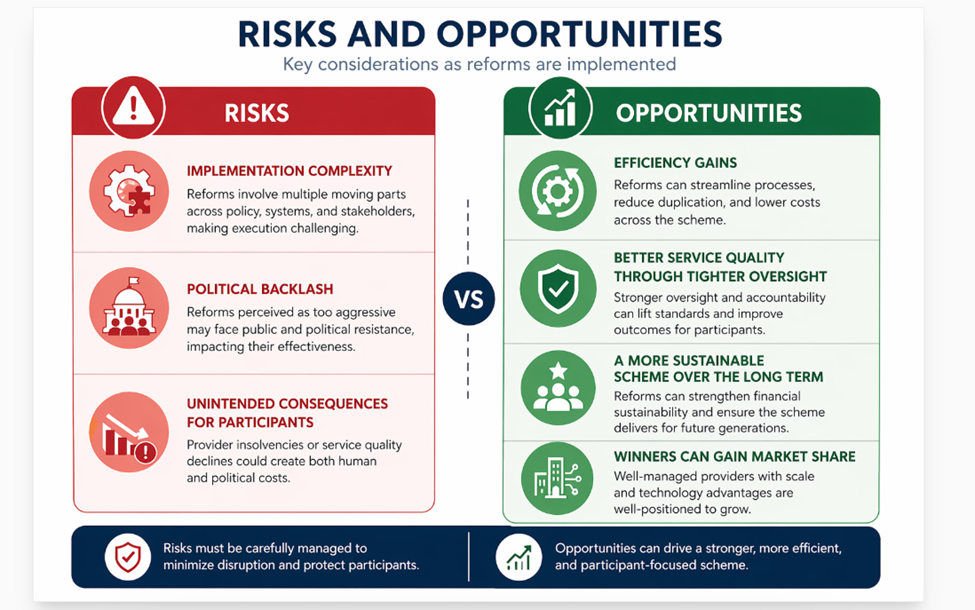
AI-Powered Image
Future Outlook
NDIS reform is a multi-year process. Savings will materialise progressively as eligibility changes, assessment reforms and provider oversight measures take effect. The economic impact will be felt unevenly across sectors and geographies. Political and advocacy pressure will continue to shape implementation.
Conclusion
The NDIS reform plan is a necessary step toward fiscal sustainability but carries real economic and human consequences. For investors, the reforms create a more disciplined environment that rewards quality providers and penalises weaker operators. For policymakers, the challenge is to deliver the savings while maintaining the scheme’s core mission of supporting Australians with disability. For the economy, the fiscal benefits will compound over time, but the transitional costs must be managed carefully. The NDIS will remain a critical part of Australia’s social fabric and economic landscape — its evolution is one to watch closely.


 Nov 09, 2026





 Please wait processing your request...