
 CA
 NZ
 UK
 US
 IND

 AU

 Share
 X (Formerly Twitter)
 Whatsapp
 Facebook
 LinkedIn
 Telegram
 Email This Article
 Copy Link
 Summarize with AI
 Chat GPT
 Perplexity

Key Highlights
- Consensus buy ratings aggregate multiple analyst opinions into a single directional signal.
- The methodology involves standardisation, averaging, and interpretation across diverse rating systems.
- These ratings reflect sentiment, not certainty, and may lag real-time developments.
- Investors should treat consensus ratings as a starting point, not a final investment decision.
In modern financial markets, investors face a constant flow of information—earnings releases, macroeconomic data, industry developments, and corporate announcements. Within this complexity, consensus buy recommendations have emerged as a simplified signal designed to summarise professional opinion.
A consensus buy recommendation represents the collective view of multiple equity analysts who follow a stock. It compresses detailed research into a single label—“Buy,” “Strong Buy,” or “Outperform.” While this simplification makes investing more accessible, it also introduces risks of misinterpretation.
Understanding how these ratings are constructed—and their limitations—is essential. A consensus buy is not a guarantee of performance. It is a directional indicator shaped by methodology, assumptions, and human judgment.
What Is a Consensus Buy Recommendation?
A consensus buy recommendation is an aggregated rating derived from multiple sell-side analysts. These analysts publish opinions on stocks based on financial models, industry insights, and company-specific analysis.
When the majority of these ratings lean positive, the stock is labelled as a “Buy” or “Strong Buy.” This label reflects the average sentiment rather than a single authoritative view.
In simple terms:
A consensus buy means that most analysts currently believe the stock is likely to outperform over a given time horizon.
However, this definition carries nuance:
- It depends on how many analysts are covering the stock
- It reflects opinions at a specific point in time
- It may include outdated or “stale” ratings
The consensus is therefore a snapshot—not a prediction.
How Consensus Ratings Are Built
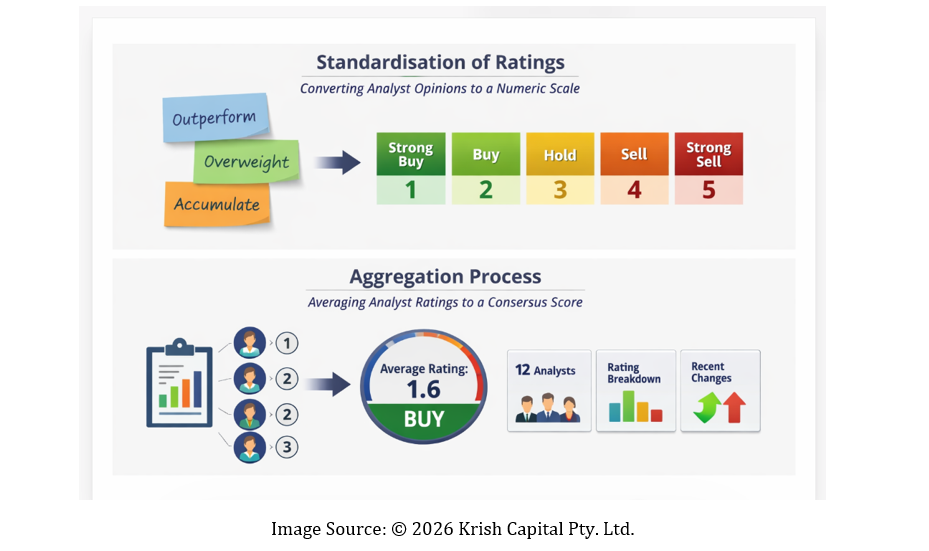
Analyst Coverage
The process begins with equity analysts from investment banks and research firms. Each analyst evaluates a company using:
- Financial models
- Industry comparisons
- Management guidance
- Macroeconomic assumptions
They then assign a rating such as Buy, Hold, or Sell, along with a price target.
Consensus Price Targets
Alongside ratings, analysts provide price targets. These are averaged to produce a consensus price target, indicating expected future price levels.
However, ratings and price targets can diverge—highlighting differences in risk perception or time horizon.
Handling Data Limitations
Not all stocks have equal analyst coverage.
- Large-cap stocks: 20–30 analysts
- Small-cap stocks: 1–5 analysts
Lower coverage reduces reliability and increases sensitivity to individual opinions.
Why Investors Pay Attention to Consensus Ratings
Information Compression
Consensus ratings condense extensive research into a simple signal, helping investors navigate information overload.
Professional Insight
Analysts have access to management teams, industry data, and proprietary models, adding credibility to their views.
Screening Tool
Investors often use consensus ratings to shortlist stocks before conducting deeper analysis.
Behavioral Anchoring
Ratings act as psychological anchors, influencing decision-making and reinforcing confidence.
Strengths of Consensus Buy Recommendations
- Aggregated Expertise
By combining multiple viewpoints, consensus ratings reduce reliance on a single opinion.
- Market Sentiment Indicator
They provide a quick snapshot of how professionals view a stock.
- Efficient Filtering
Useful for narrowing down investment opportunities across large stock universes.
- Relative Signal Value
Changes in consensus (upgrades/downgrades) can indicate shifting sentiment and potential catalysts.
Limitations and Risks
- Lagging Nature
Consensus ratings often lag new information because analysts update their views after events occur.
- Herding Behaviour
Analysts may align with peers to avoid reputational risk, reducing diversity of opinion.
- Positive Bias
Sell-side ratings are often skewed toward Buy, with fewer Sell recommendations.
- Stale Data
Older ratings may still influence the consensus even if conditions have changed.
- Sector Differences
A “Buy” in one sector may not carry the same implications in another due to differing risk profiles.
- Limited Coverage
Stocks with few analysts can have misleading consensus ratings.
Consensus Ratings vs Price Targets
While related, these two metrics serve different purposes:
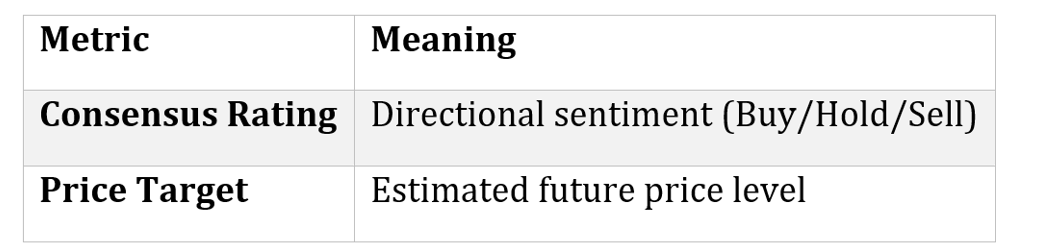
A stock can have:
- A Buy rating but limited upside
- A Hold rating with significant upside
This divergence highlights the importance of analysing both metrics together.
Common Mistakes Investors Make
- Treating Consensus as a Guarantee
A consensus buy does not ensure positive returns.
- Ignoring Analyst Count
A rating based on two analysts is far less reliable than one based on twenty.
- Overlooking Recency
Old ratings may distort the current picture.
- Blindly Following Ratings
Investors often skip underlying analysis and rely solely on consensus.
- Ignoring Risk Factors
Consensus ratings focus on expected returns, not downside risks.
How to Use Consensus Ratings Effectively
- Use as a Starting Point
Treat consensus ratings as an initial filter, not a final decision.
- Check Analyst Coverage
More analysts generally mean more reliable consensus.
- Analyse Rating Distribution
Look beyond the average—understand how opinions are spread.
- Compare with Price Targets
Evaluate whether expected upside aligns with the rating.
- Monitor Changes
Upgrades and downgrades can signal changing sentiment.
- Combine with Fundamental Analysis
Always validate consensus with financials, valuation, and macro context.
Sector and Market Cycle Considerations
Bull Markets
Consensus ratings tend to skew more positive as optimism increases.
Bear Markets
Ratings may lag declines, with downgrades coming after price corrections.
Sector Variability
- Growth sectors: Higher Buy concentration
- Defensive sectors: More Hold ratings
Understanding these dynamics helps contextualise consensus signals.
Institutional vs Retail Use
Institutional Investors
- Use consensus as a screening tool
- Focus on underlying research reports
- Combine with proprietary analysis
Retail Investors
- Often rely on headline ratings
- May lack access to detailed reports
- Risk over-reliance on simplified signals
Final Takeaway
Consensus buy recommendations are a useful tool—but only when understood correctly. They represent aggregated sentiment, not certainty.
When used alongside fundamental analysis, valuation metrics, and risk assessment, they can enhance decision-making. When used in isolation, they can mislead.
The key is to treat consensus ratings as information—not instruction.
FAQs
- Does a consensus buy mean a stock will go up?
No. It reflects positive analyst sentiment, not guaranteed future performance.
- How many analysts are needed for a reliable consensus?
Typically at least 5–10 analysts provide a more robust and reliable consensus.
- Why do most stocks have Buy ratings?
Sell-side analysts often exhibit positive bias due to industry incentives and relationships.
- Should beginners rely on consensus ratings?
They can be useful as a starting point, but should always be combined with independent research.


 Nov 09, 2026





 Please wait processing your request...