
 CA
 NZ
 UK
 US
 IND

 AU

 Share
 X (Formerly Twitter)
 Whatsapp
 Facebook
 LinkedIn
 Telegram
 Email This Article
 Copy Link
 Summarize with AI
 Chat GPT
 Perplexity

Meta Highlights
- Agentic AI may shift payments from user-initiated actions toward autonomous, goal-driven transaction execution.
- A three-layer model of intent, authorization and settlement highlights where agentic systems may add value.
- Liquidity optimization, compliance monitoring and operational resilience are emerging use cases under evaluation.
- Governance, traceability and deterministic settlement remain central to managing risks as adoption evolves.
Artificial intelligence is evolving beyond tools that assist users toward systems capable of acting on their behalf. Often described as agentic AI, these systems can interpret goals, make decisions, and execute tasks across digital environments with limited human intervention. In payments, this could mark a structural shift: from transactions initiated directly by people or firms toward payments increasingly orchestrated by intelligent agents.
This evolution matters because payments are built on certainty. Every transfer relies on deterministic processes—rules-based systems designed for precision, finality, and trust. By contrast, AI systems often operate probabilistically, generating outcomes based on inference and adaptive learning. Reconciling those two models may define the future architecture of payments.
Moving from User Commands to Agent-Mediated Payments
Traditional digital payments rely on explicit user actions: a consumer enters card details, a treasurer approves a transfer, or a business schedules supplier payments. Agentic AI introduces the possibility of systems acting within predefined objectives rather than waiting for instructions at each step.
A corporate treasury agent, for example, could monitor liquidity across accounts, optimize funding positions, and initiate transfers based on real-time conditions. A consumer-facing agent could manage recurring household payments, compare settlement options, and choose the most efficient route based on cost, speed, or rewards. In each case, humans define goals and constraints, while the agent handles execution.
This could alter how payment decisions are made, especially where speed, complexity, or data intensity exceed human capacity.
A Three-Layer Framework for Agentic Payments
AI Powered Image
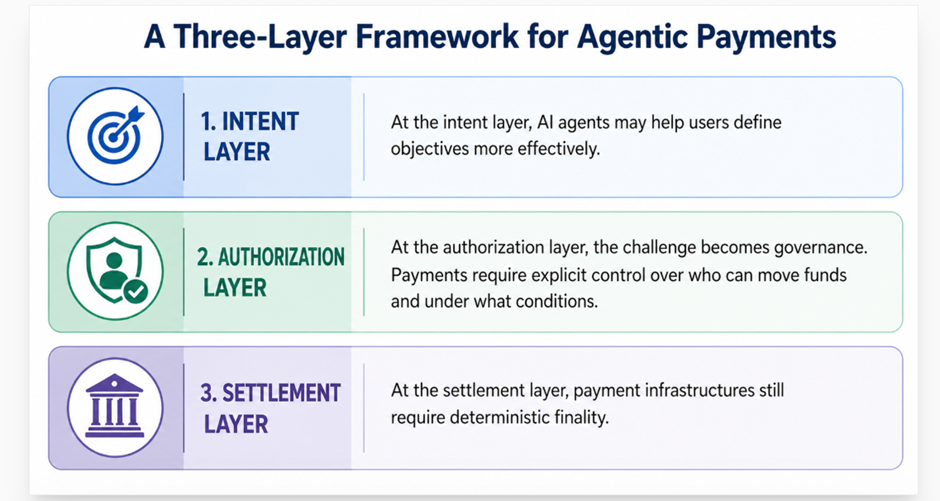
A useful way to assess this transformation is through three layers: intent, authorization, and settlement.
At the intent layer, AI agents may help users define objectives more effectively. Rather than instructing a system to pay a supplier today, a business might direct an agent to optimize working capital while meeting payment obligations. The AI interprets the objective and determines actions consistent with those goals.
At the authorization layer, the challenge becomes governance. Payments require explicit control over who can move funds and under what conditions. Agentic systems may introduce dynamic authorization models, where agents operate within programmable limits, spending policies, or risk thresholds. This could enhance efficiency, but only if oversight remains robust.
At the settlement layer, payment infrastructures still require deterministic finality. Clearing and settlement systems depend on precision, and autonomous agents would likely operate around—not replace—these core rails. Here, agentic AI may improve routing, timing, and liquidity decisions while leaving settlement integrity intact.
Liquidity, Compliance and Operational Efficiency
One of the more immediate applications may lie in liquidity management. Agentic systems could continuously evaluate cash positions, funding costs, and payment priorities, adjusting decisions in real time. For financial institutions and corporates, that could improve capital efficiency and reduce operational friction.
Compliance is another area where agentic AI may have influence. Monitoring sanctions, fraud indicators, anti-money laundering controls, and jurisdictional requirements is increasingly complex. Intelligent agents could help automate surveillance, escalate anomalies, and support real-time risk screening.
Operational resilience may also benefit. In stressed conditions, agents could reroute payment flows, identify bottlenecks, or manage fallback procedures faster than manual systems. Yet resilience gains depend heavily on design safeguards and the avoidance of common-mode failures.
Risks at the Intersection of AI and Payments
The opportunities are significant, but so are the risks. One concern is opacity. If agents make payment decisions through complex reasoning paths that are difficult to audit, traceability may weaken. That is problematic in systems where accountability is central.
Cybersecurity risks may also increase. Autonomous agents interacting across networks could create new attack surfaces, particularly if compromised agents can initiate or influence transactions at scale.
There is also the possibility of systemic effects. If many institutions deploy similar models trained on similar data, synchronized behaviors could amplify market or liquidity stresses. In this sense, agentic payments raise questions not only about firm-level risk but also financial stability.
Legal and regulatory uncertainty remains another unresolved issue. Questions around liability, delegated authority, and dispute resolution become more complex when autonomous systems participate in payment decisions.
Governance Will Shape the Outcome
The trajectory of agentic AI in payments is unlikely to be determined by technology alone. Institutional design, regulatory frameworks, and governance standards may prove equally important. The core challenge is enabling adaptive intelligence at the edge of the system while preserving control, transparency, and finality at its core.
Rather than replacing payment infrastructure, agentic AI may increasingly sit above it—optimizing decisions, improving efficiency, and reshaping user interaction with financial systems. But whether that leads to more resilient and efficient payments will depend less on autonomous capability itself, and more on how those capabilities are constrained, supervised, and integrated.
In that sense, the future of agentic payments may be as much about trust architecture as artificial intelligence.


 Nov 09, 2026





 Please wait processing your request...