
 CA
 NZ
 UK
 US
 IND

 AU

 Share
 X (Formerly Twitter)
 Whatsapp
 Facebook
 LinkedIn
 Telegram
 Email This Article
 Copy Link
 Summarize with AI
 Chat GPT
 Perplexity

Highlights
- A $500,000 share portfolio can generate different levels of annual income depending on the overall dividend yield and portfolio composition.
- A hypothetical yield of 3% would equal $15,000 in annual income, while a 4% yield would equal $20,000 before tax and other considerations.
- Higher dividend yields do not automatically mean better investment outcomes, as income can change and share prices can fluctuate.
- Diversification and the balance between income and capital growth can influence the long-term performance of a share portfolio.
Building a $500,000 share portfolio can represent a significant financial milestone. But once that level is reached, another question often comes into focus: how much income could the portfolio potentially generate?
The answer depends largely on how the money is invested. Two portfolios with the same starting value can produce very different income outcomes. A portfolio focused on dividend-paying companies may generate more regular cash distributions, while one tilted towards growth shares may provide a lower level of immediate income but greater potential for capital appreciation.
Understanding the relationship between portfolio size, dividend yield and investment strategy can provide a clearer picture of the income that $500,000 invested in shares may potentially produce.
What Could a $500,000 Portfolio Generate?
One simple way to estimate potential portfolio income is to apply an assumed dividend yield to the total investment value.
For a $500,000 share portfolio, the hypothetical annual income could look like this:
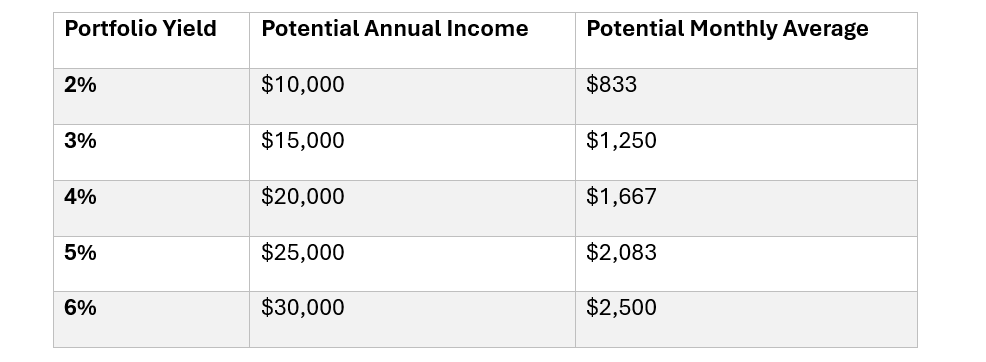
These figures are simple illustrations rather than guaranteed outcomes. Actual income can vary depending on dividend payments, portfolio changes and market conditions.
For example, a portfolio yielding 4% would theoretically generate $20,000 per year. However, companies can increase, reduce or suspend dividends, meaning the income received may change from one year to another.
Dividend Yield Can Shape the Income Outcome
Dividend yield is one of the main factors influencing how much income a share portfolio may generate. It generally compares the annual dividend paid by a company with its share price.
A higher portfolio yield may result in greater immediate income. However, investors may also need to consider why a particular share offers a high yield. In some cases, a rising yield can result from a falling share price rather than an increase in the dividend.
This means yield alone may not provide a complete picture.
The sustainability of company earnings and dividend payments can also matter. A business that generates sufficient cash to support its distributions may offer a different risk profile from a company paying a high dividend that may be difficult to maintain.
For a $500,000 portfolio, the focus may therefore extend beyond simply finding the highest available yields.
Balancing Income and Capital Growth
Income is only one component of the potential return from a share portfolio. Changes in the value of the underlying investments can also affect overall wealth.
A portfolio concentrated entirely on high-yielding shares may generate more immediate cash flow but could provide different growth prospects compared with a more diversified portfolio. Meanwhile, companies that reinvest a larger portion of their earnings may pay lower dividends while pursuing business expansion.
The appropriate balance between income and growth can depend on an investor’s objectives.
Someone relying on a portfolio to help fund living expenses may place greater emphasis on regular distributions. An investor with a longer time horizon may be more willing to accept lower current income in exchange for potential capital growth.
A combination of income-producing and growth-oriented investments may also be considered as part of a broader portfolio strategy.
Diversification Can Influence Income Stability
A $500,000 portfolio invested in only a small number of companies may be more exposed to changes in individual dividend policies.
If one major holding reduces its dividend, the effect on total portfolio income could be significant. Spreading investments across different companies and sectors may reduce reliance on a single source of income.
Diversification does not eliminate investment risk or guarantee consistent dividends. However, it can help distribute exposure across different businesses and areas of the market.
Investors may also consider the timing of dividend payments. Companies do not necessarily pay dividends at the same time, meaning annual income may arrive unevenly throughout the year rather than as a consistent monthly payment.
Reinvesting Income Could Change the Long-Term Picture
Not every investor needs to spend the income generated by a share portfolio immediately. Reinvesting dividends can potentially increase the amount of capital invested over time.
When dividends are used to purchase additional shares, those new holdings may also generate future income. Over a long investment period, this process can contribute to the growth of both the portfolio and its potential income-producing capacity.
For investors who eventually want to rely on portfolio income, the accumulation years may therefore be used to build a larger base of income-producing assets.
The decision to reinvest or withdraw dividends will depend on personal financial needs and investment objectives.
Looking Beyond the Headline Income Figure
A $500,000 share portfolio has the potential to generate a meaningful stream of investment income, but there is no fixed amount that investors can expect to receive.
At a hypothetical 3% yield, the portfolio could produce $15,000 per year. At 5%, the figure could rise to $25,000. However, higher income expectations may also involve different levels of investment risk.
Portfolio composition, dividend sustainability, diversification and capital growth can all influence the long-term outcome.
For investors assessing the income potential of $500,000 invested in shares, the key consideration may not simply be how much income the portfolio can generate today. It may also be how sustainable that income could be and how the portfolio may evolve over time.


 Nov 09, 2026





 Please wait processing your request...