
 CA
 NZ
 UK
 US
 IND

 AU

 Share
 X (Formerly Twitter)
 Whatsapp
 Facebook
 LinkedIn
 Telegram
 Email This Article
 Copy Link
 Summarize with AI
 Chat GPT
 Perplexity

Key Highlights
- Multifactor productivity in finance combines income, investments, and time to measure real wealth creation.
- Increasing income alone does not guarantee better financial outcomes.
- Investments act as capital, enabling money to grow independently of effort.
- Time is a critical but often ignored input in financial decision-making.
- Balancing all three factors leads to sustainable long-term wealth.
In economics, productivity is often defined as the output generated from a combination of inputs. Translating this concept into personal finance offers a powerful way to rethink wealth creation. Instead of focusing solely on income, financial productivity considers how effectively you use multiple resources—your earnings, your invested capital, and your time—to generate financial outcomes.
This broader perspective highlights a key truth: wealth is not built by income alone. It is the result of how efficiently different financial inputs work together.
Income: The Primary Input
Income represents the most visible component of financial productivity. Salaries, business earnings, and side income streams form the foundation of any financial plan. For many individuals, increasing income appears to be the most direct path to improving financial wellbeing.
However, income has natural limitations. It is often tied to time and effort, meaning there is a ceiling to how much one can earn without increasing hours worked or taking on additional responsibilities. This makes income a necessary but insufficient driver of long-term wealth.
The key is not just to earn more, but to ensure that income is allocated efficiently toward other wealth-building channels.
Investments: Turning Money into Capital
If income is the starting point, investments are the engine of financial growth. Investments allow individuals to convert earned money into capital that can generate returns over time. This includes assets such as equities, real estate, superannuation funds, and other financial instruments.
Unlike income, investments are not directly tied to time. Once deployed, capital can grow passively, benefiting from compounding and market returns. This introduces leverage into personal finance—your money begins to work independently.
The role of investments in financial productivity is therefore critical. They amplify the output generated from income, transforming short-term earnings into long-term wealth.
Time: The Overlooked Resource
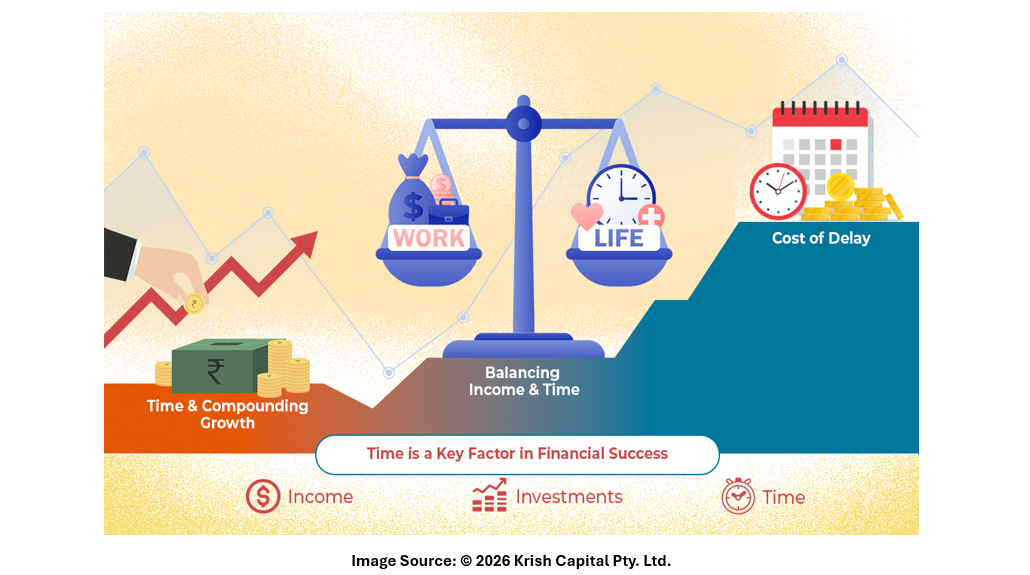
Time is perhaps the most underestimated factor in personal finance. Every financial decision involves a trade-off with time—whether it is the time spent earning, managing investments, or planning finances.
Time also plays a crucial role in compounding. The earlier investments are made, the longer they have to grow, significantly increasing overall returns. Conversely, delayed decisions can reduce the effectiveness of even high income or strong investment choices.
Additionally, time affects lifestyle and wellbeing. A financial strategy that maximises income but consumes all available time may not lead to a balanced or sustainable outcome. Therefore, time must be considered alongside income and investments when evaluating financial productivity.
Balancing the Three Factors
The concept of multifactor productivity becomes most relevant when these three elements—income, investments, and time—are viewed together. Each factor interacts with the others, and an imbalance can reduce overall efficiency.
For example, high income without effective investment leads to limited wealth accumulation. Similarly, strong investments without sufficient income may restrict the ability to scale. Excessive time spent earning without attention to investments can also reduce long-term financial outcomes.
An efficient financial system aligns all three:
- Income funds investments
- Investments grow wealth over time
- Time is allocated to maximise both earning and compounding opportunities
This integrated approach ensures that financial resources are not just increased, but optimised.
Shifting from Effort to Efficiency
Traditional financial thinking often emphasises effort—working harder, earning more, saving more. While these actions are important, they do not necessarily lead to optimal results. Multifactor productivity shifts the focus toward efficiency.
Efficiency in personal finance means generating better outcomes from the same or fewer inputs. This could involve improving investment allocation, automating savings, or prioritising high-impact financial decisions. Over time, small improvements in efficiency can significantly enhance wealth creation.
A Framework for Long-Term Wealth
Viewing personal finance through the lens of multifactor productivity provides a structured framework for decision-making. It encourages individuals to assess not just how much they earn, but how effectively they deploy resources across income, investments, and time.
This perspective also supports long-term thinking. Rather than chasing short-term gains, it prioritises sustainable growth, balance, and adaptability. As financial circumstances change, the ability to adjust these three factors becomes essential.
Conclusion
Financial productivity is not a single-dimensional concept. It is shaped by the interaction of income, investments, and time. Focusing on one factor in isolation can limit outcomes, while a balanced approach can significantly enhance wealth creation.
By understanding and applying multifactor productivity to personal finance, individuals can move beyond traditional measures of success and build a more efficient, resilient, and sustainable financial future.


 Nov 09, 2026





 Please wait processing your request...