
 CA
 NZ
 UK
 US
 IND

 AU

 Share
 X (Formerly Twitter)
 Whatsapp
 Facebook
 LinkedIn
 Telegram
 Email This Article
 Copy Link
 Summarize with AI
 Chat GPT
 Perplexity

Highlights
- Australia’s Inflation is forecast to reach 5 per cent through the year to the June quarter 2026, largely due to higher oil prices.
- The Middle East conflict and resulting Supply shock are increasing pressure on households, businesses and supply chains.
- Australia’s economic growth is expected to slow from 2¼ per cent in 2025–26 to 1¾ per cent in 2026–27.
- Unemployment remains low, workforce participation is high and wages growth continues to support the economy.
- Economic growth is projected to recover to 2¼ per cent in 2027–28, supported by improving real household incomes.
Australia’s economy is entering a period of heightened uncertainty as global geopolitical tensions continue to affect oil prices, inflation and household costs. The economic effects of the Middle East conflict are now flowing through supply chains, transport costs and energy markets, creating broader pressure across the domestic economy.
While Australia is not immune to these developments, policymakers continue to argue that the country is approaching these challenges from a position of relative economic strength. Inflation remains elevated, growth is expected to moderate, and households are likely to continue navigating higher living costs over the near term.
For everyday Australians, understanding how these macroeconomic trends influence mortgages, savings, wages, employment and spending decisions is becoming increasingly important.
Why Global Oil Prices Matter to Australia
Oil prices influence far more than petrol costs. When global oil prices rise sharply, the effects can spread throughout the economy. Transport becomes more expensive, freight costs increase, Manufacturing expenses rise, and businesses often face higher operating costs.
These pressures can eventually flow through to consumers in the form of higher prices for goods and services. This process contributes to inflation, which refers to the broad increase in prices across the economy over time.
According to the outlook, much of the expected rise in inflation during 2026 is linked to the sharp increase in oil prices triggered by supply disruptions associated with the Middle East conflict. Supply shocks occur when the availability of key commodities or materials becomes constrained, pushing prices higher globally.
Australia, despite being geographically distant from the conflict, still feels the impact because energy and Commodity markets are globally connected.
Inflation Expected to Remain Elevated
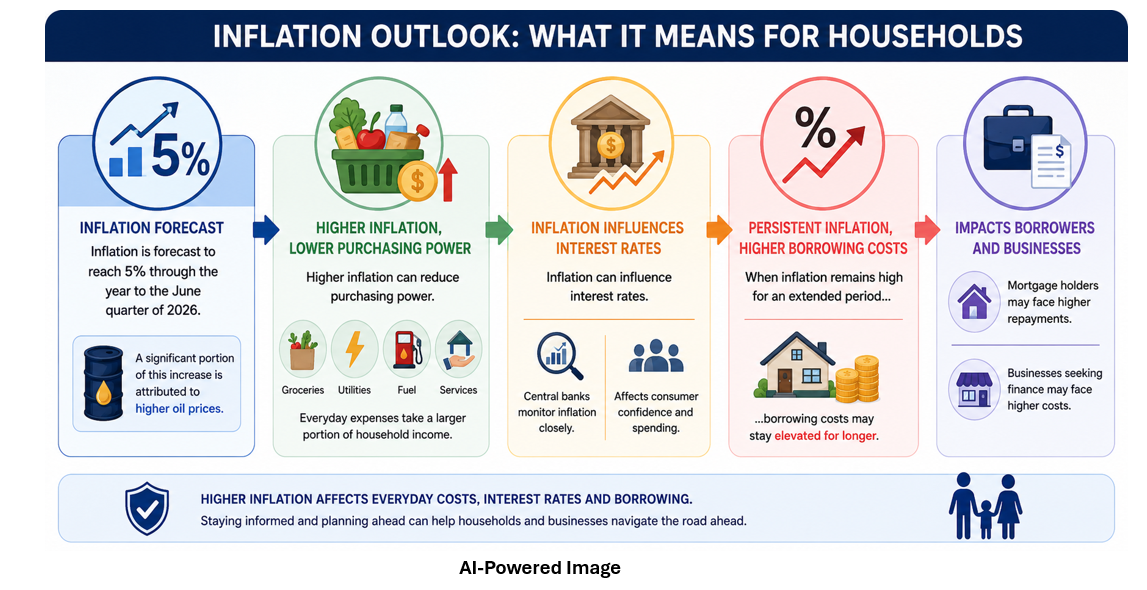
Inflation is forecast to reach 5 per cent through the year to the June quarter of 2026. A significant portion of this increase is attributed to higher oil prices.
For households, higher inflation can reduce purchasing power. This means families may find that everyday expenses such as groceries, utilities, fuel and services consume a larger portion of household income.
Inflation can also influence interest rates. Central banks often monitor inflation closely because persistent price increases can affect consumer confidence, spending behaviour and long-term economic stability.
When inflation remains high for an extended period, borrowing costs may stay elevated for longer, affecting Mortgage holders and businesses seeking finance.
Slower Economic Growth Forecast
Economic growth in Australia is forecast to slow from 2¼ per cent in 2025–26 to 1¾ per cent in 2026–27.
Economic growth measures how much the economy expands over time through increased production, spending and Investment activity. Slower growth does not necessarily mean the economy is shrinking, but it can indicate weaker Business activity and softer consumer Demand.
Higher prices often weigh on economic activity because households and businesses become more cautious with spending. Consumers may delay discretionary purchases, while businesses may postpone expansion plans or investment decisions.
This combination of rising costs and moderating growth is often challenging for policymakers because it places pressure on both inflation management and economic stability.
Why Australia Is Still Considered Relatively Resilient
Despite these challenges, Australia is described as being in a comparatively stronger position than many advanced economies.
The outlook notes that Australia’s economy is growing faster than every major advanced economy. Unemployment remains low, workforce participation remains high, and wages growth continues to be solid.
Low unemployment is generally viewed as a positive indicator because it suggests businesses are still hiring and economic activity remains relatively stable. A high participation rate means more Australians are either employed or actively seeking work, reflecting ongoing engagement in the labour market.
Solid wages growth may also help households partially offset rising living costs. However, the balance between wage increases and inflation remains important. If inflation rises faster than wages, households may still experience pressure on real purchasing power.
Public Finances and Government Stability
Another Factor supporting Australia’s economic position is the strength of public finances.
The outlook states that Australia’s gross Debt remains lower than every major advanced economy. Lower government debt can provide policymakers with greater flexibility during periods of economic uncertainty.
Governments with relatively stronger fiscal positions may have more capacity to support households, infrastructure projects or economic programs if conditions deteriorate further.
Strong public finances can also support investor confidence and broader financial market stability during volatile global periods.
Recovery Expectations Beyond 2027
While near-term conditions remain challenging, economic growth is expected to recover to 2¼ per cent in 2027–28.
The projected recovery is expected to be supported by improvements in real household incomes. Real income refers to income adjusted for inflation, meaning it reflects actual purchasing power rather than nominal wage growth alone.
If inflation moderates over time while wages remain supportive, households may regain some spending capacity. This could help strengthen consumer demand and broader economic activity.
What Households May Focus on During Uncertain Periods
Periods of higher inflation and slower growth often encourage households to reassess budgeting, savings and spending priorities.
Many households may focus more closely on managing discretionary expenses, monitoring Interest Rate movements and maintaining financial flexibility. Others may prioritise emergency savings or review long-term financial plans to account for changing economic conditions.
Economic cycles are a normal part of broader financial systems, and conditions can shift over time depending on global developments, inflation trends and policy responses.
While global shocks can create uncertainty, Australia’s labour market strength, public finances and projected long-term recovery remain key areas closely watched by economists, businesses and households alike.
FAQs
Q: Why are global oil prices affecting Australia’s economy?
A: Australia is connected to global energy and commodity markets. Higher oil prices can increase transport, manufacturing and business costs, which may eventually flow through to consumer prices and broader inflation.
Q: What does a 5 per cent inflation forecast mean for households?
A: Higher inflation means the cost of everyday goods and services may rise faster, reducing household purchasing power and placing pressure on budgets.
Q: Why is economic growth expected to slow?
A: Higher prices and increased uncertainty may cause households and businesses to reduce spending and investment activity, leading to slower economic growth.
Q: What does it mean when Australia is described as economically resilient?
A: The outlook highlights Australia’s relatively low unemployment, high workforce participation, solid wages growth and comparatively lower public debt as indicators of resilience.
Q: What are real household incomes?
A: Real household incomes refer to income adjusted for inflation. They measure how much purchasing power households actually have after accounting for rising prices.


 Nov 09, 2026





 Please wait processing your request...