
 CA
 NZ
 UK
 US
 IND

 AU

 Share
 X (Formerly Twitter)
 Whatsapp
 Facebook
 LinkedIn
 Telegram
 Email This Article
 Copy Link
 Summarize with AI
 Chat GPT
 Perplexity

Key Highlights
- Geopolitical conflict is driving ASX valuation dislocations and shifting capital allocation trends.
- Sector divergence is widening, with energy outperforming while materials and growth equities face compression.
- Treasury Indexed Bonds now offer real yields near 3% above inflation, a compelling opportunity for capital preservation.
- Australia's AUD 4.5 trillion superannuation pool provides structural liquidity support during market stress.
- Active fund managers are targeting mispriced assets amid elevated volatility and cross-asset repricing.
Australia does not need troops on the ground for overseas conflict to hit superannuation balances. The economy runs on commodity exports, iron ore, LNG, coal, and gold make up a large share of ASX earnings, creating three fast-moving transmission channels: commodity prices, risk sentiment, and the Australian dollar, which acts as both a commodity currency and a risk proxy.
The ASX 200 hit an all-time high above 9,200 in February 2026. By late March, as Middle East tensions escalated, it had fallen roughly 8% to 8,461. That selloff was the opportunity, and it was not uniform.
Where the gaps appeared
 Data source: ASX, Analysis by Kalkine Group
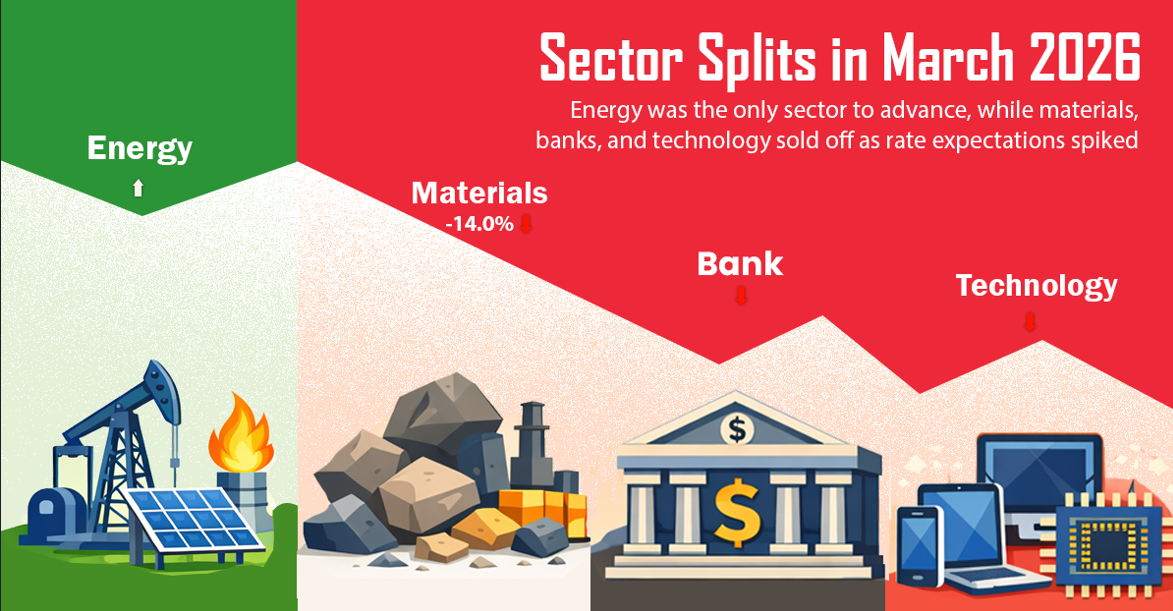
The March 2026 shock produced a striking sector split. Energy was the only sector to advance; materials fell more than 14%. Meanwhile, banks and technology sold off as rate expectations repriced sharply upward.
This is where active management earns its keep. When a share price falls because of sector pressure, not because fundamentals have changed, a discount to fair value opens. That decoupling is temporary, and active managers specifically target the reversion.
Why Australian super is structurally different
Australia's AUD 4.5 trillion superannuation system receives compulsory employer contributions every quarter regardless of market conditions. Total contributions reached AUD 215.6 billion in the year to September 2025, up 12.7%, creating a steady floor of buying pressure most other markets simply don't have.
Large super funds, however, rebalance methodically and cannot easily concentrate into high-conviction sectors during a crisis window. Active managers can. During the March shock, managers who held energy overweights and reduced materials exposure ahead of escalation significantly outperformed both super benchmarks and passive index products. Super funds provide structural stability; active managers provide tactical flexibility. The two are complementary, not competing.
The RBA, inflation, and the case for inflation bonds
The RBA cut rates three times in 2025. Then conflict-driven energy prices pushed trimmed mean inflation to 3.4% annualised, prompting a hike to 4.10% in March 2026, with CBA economists forecasting a further move to 4.35% in May. Higher rates have compressed long-duration technology valuations, explaining underperformance from names like Xero, WiseTech, and Atlassian.
But rising rates have also created a standout opportunity in fixed income, specifically in Treasury Indexed Bonds. Unlike standard bonds that lock in expected inflation, these government securities pay a real yield plus actual, realised CPI. You fix the real return; the inflation component floats with whatever the economy delivers.
Real yields on 10 to 15-year government bonds reached almost 3% in late March. In practical terms: investors buying today can lock in a risk-free federal government return of inflation plus approximately 3%, a figure that exceeds the target of many conservative balanced funds and sits at the lower bound of most balanced fund benchmarks, with zero credit risk. For context, the average term deposit rate has tracked closer to just 1% above inflation this century.
The mark-to-market catch is real. If real yields rise further, bond prices fall before maturity. But for investors with a genuine buy-and-hold orientation, the interim volatility is largely irrelevant. The real return is locked in at purchase. Inflation bonds also offer asymmetric protection across the two most plausible conflict scenarios: if inflation stays elevated at 5%, coupons and capital value rise in step; if conflict resolves and recession follows, locked-in real returns become even more valuable as rates collapse.
What fund managers are actually doing
The consensus is not to maximise conflict-driven gains. It is to avoid being caught off-guard by either sudden escalation or rapid de-escalation, both of which can quickly erase positions built on conflict themes.
The practical response: increase real asset allocations in energy, add currency and commodity hedges, and prioritise downside protection over aggressive risk-taking. Large-cap resource exporters and infrastructure businesses with government contract revenue are favoured for their manageable downside.
On currency, the AUD's behaviour during the March shock deserves particular attention. The dollar initially weakened, reflecting its risk-proxy character, before partially recovering as surging commodity export values reasserted its terms-of-trade support. This push-pull dynamic means unhedged offshore allocations can produce wildly different outcomes depending on the sequencing of moves within a single week. Managers with active currency overlay programs captured meaningful additional return during the March volatility simply by anticipating this pattern: hedging offshore equity exposure during the initial risk-off leg, then selectively lifting hedges as commodity prices translated back into AUD strength. For Australian investors with significant global allocations, currency management is no longer a secondary consideration. In a conflict environment, it can rival sector selection as a driver of relative performance.
Within fixed income, a growing number of managers are rotating toward Treasury Indexed Bonds as a core defensive allocation. In an environment where the inflation path is genuinely unknown, owning a bond that pays actual inflation rather than expected inflation is a structurally better hedge, and the current real yield premium makes the case unusually compelling.
The bottom line
The most overlooked opportunity right now may not be in equities at all. For investors whose primary goal is protecting purchasing power, government inflation bonds are priced at levels not seen in over a decade, and that window will not stay open indefinitely.
For growth-oriented investors, active management of sector tilts remains the right framework. For those closer to retirement, anchoring a portion of the portfolio in inflation-linked bonds at today's real yields may prove to be the defining allocation decision of this cycle.
Opportunity exists. But it is conditional, cyclical, and unevenly distributed, across sectors, asset classes, and investor profiles. Understanding the mechanics matters, whether you are a fund manager or a super fund member watching your balance.


 Nov 12, 2026





 Please wait processing your request...