
 CA
 NZ
 UK
 US
 IND

 AU

 Share
 X (Formerly Twitter)
 Whatsapp
 Facebook
 LinkedIn
 Telegram
 Email This Article
 Copy Link
 Summarize with AI
 Chat GPT
 Perplexity

Building a long-term portfolio on the ASX does not require a large lump sum. For many Australians, a steady contribution of $250 a month is realistic, and the discipline of regular investing can produce meaningful outcomes when combined with sensible diversification and patience. The conversation around small, regular investing has intensified in recent years as more brokers reduce fees, more ETFs list, and education resources become more accessible. This article walks through the framework, options and trade-offs without making any specific buy or sell recommendation, and highlights the questions investors typically work through when designing such a plan.
The case for regular investing
Regular investing - sometimes called dollar-cost averaging - means putting a set dollar amount into the market on a recurring schedule. By spreading purchases across time, investors buy more units when prices are lower and fewer units when prices are higher. This does not eliminate market risk, but it can reduce timing pressure and smooth the entry experience for many investors.
$250 a month adds up to $3,000 a year, and over multiple years the compounding effect can become powerful. Modest but consistent contributions, when combined with reinvested distributions, can outperform a more sporadic approach. According to long-run data on the Australian share market, broad-based equity exposure has delivered positive real returns over rolling 10- and 20-year periods, although individual years have varied.
There is also a behavioural benefit. Pre-committing to a regular schedule helps remove the temptation to time the market, which research consistently suggests is difficult to do successfully. By automating contributions, investors can keep their plan running through both quiet phases and volatile ones, taking advantage of price dispersion in either direction.
Setting up the framework
A long-term ASX portfolio starts with clarity on goals, time horizon and risk tolerance. A 25-year-old saving for a house deposit in five years has very different needs from a 40-year-old saving for retirement in 25 years. Time horizon is one of the most important inputs because it determines how much volatility can reasonably be tolerated.
From there, asset allocation comes into play. Most regular investors balance growth assets such as Australian shares, international shares and listed property with defensive assets such as fixed income and cash. The exact mix depends on individual circumstances, and many investors revisit it periodically.
Defining a simple rule for rebalancing is also useful. Some investors rebalance once a year, others when an asset class drifts more than a chosen percentage from its target. Either approach helps prevent any one position from dominating the portfolio after a strong run, which can otherwise erode diversification over time.
Diversification at $250 a month
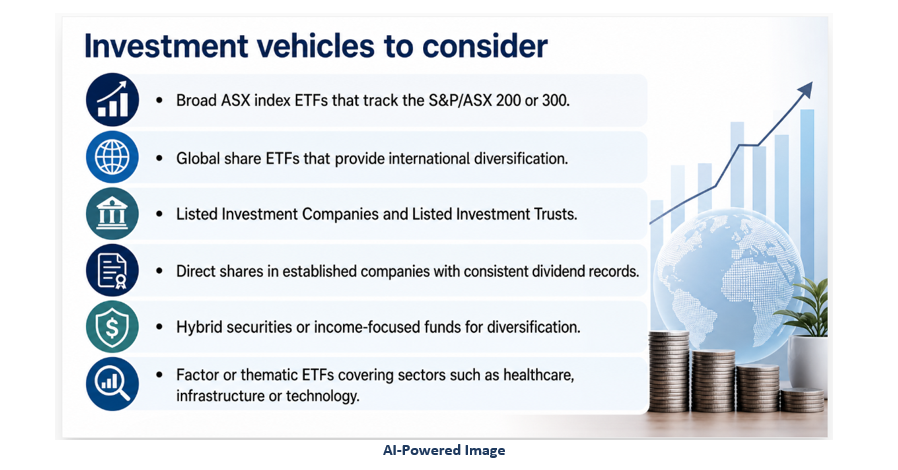
With small monthly contributions, brokerage costs become a meaningful consideration. ETFs and managed funds with low minimums are often well suited to this strategy because they provide instant diversification across many securities through a single purchase. Some investors choose to alternate between two or three ETFs each month to keep costs down while still building exposure across asset classes.
Direct shares can be an alternative, but the trade-off is the challenge of building a diversified portfolio with $250 at a time. Common solutions include spacing out direct purchases over several months, focusing on a small number of higher-conviction ideas, or blending direct shares with ETF holdings.
Investors should also weigh the tax efficiency of their chosen structure. Holding shares in personal names is straightforward, but those with longer time horizons sometimes consider trusts, investment bonds or super contributions depending on their circumstances. Each has different rules, costs and access constraints.
Why this matters now
Cost-of-living pressures and elevated interest rates have made many Australians more conscious of how their savings are being deployed. Cash deposits offer better yields than they did a few years ago, but inflation can still erode real returns. For investors with multi-decade horizons, equity-style exposure remains a common building block because of its long-run track record.
Investors are watching the rise of low-cost online brokers that have reduced the fixed cost of trading, making smaller regular contributions more economic. They are also watching the rapid growth of micro-investing apps, which have lowered the barrier to entry for first-time investors.
The broader policy environment continues to highlight the importance of household financial resilience. Building a diversified portfolio outside super can complement existing retirement savings and provide flexibility for shorter-term goals. According to market updates, the share of Australians investing through ETFs has grown steadily over recent years.
Implications for portfolio design
A $250-a-month plan is more than a savings habit. It is also a test of behavioural discipline - sticking to the plan during periods of market stress is one of the most important factors in long-term outcomes. Automated contributions, set up at the same time each month, can help reduce the temptation to time the market.
Tax considerations can also influence design. Franked dividends from Australian shares carry imputation credits that can be valuable for many Australian residents, while distributions from international ETFs may have different tax characteristics. Investors are encouraged to model the after-tax outcome rather than headline yields alone.
Record-keeping deserves attention from day one. Keeping clean records of contributions, distributions and reinvestments makes annual tax preparation easier and supports better decisions about when to take profits or rebalance. Many brokers now provide consolidated annual statements, which simplifies the process compared with earlier eras.
Risks and counterpoints
Regular investing does not protect against permanent loss in any single security. Broad-based ETFs reduce single-stock risk but still carry market and sector risk. Volatility can be uncomfortable in the short term, and during sharp drawdowns the temptation to stop or reverse contributions can be strong. According to long-run studies, investors who continued contributions through downturns often benefited from buying at lower prices.
Counterpoints include the argument that lump-sum investing has historically produced higher average returns when long-run upward drift is taken into account. The decision between lump sums and regular contributions is rarely one-size-fits-all and depends on available capital and personal preferences.
There is also concentration risk to consider. The ASX 200 has a heavy weighting toward financials and resources, which can leave portfolios more exposed to those sectors than some investors realise. Pairing a domestic index ETF with global exposure can help address this issue.
How a sample plan might evolve over decades
Long-term outcomes from regular investing depend on three factors above all: the contribution rate, the rate of return, and the time horizon. Even modest improvements in any of the three can produce materially different end-point outcomes. A consistent $250 a month, growing slightly with wages over time and earning a long-run return broadly in line with diversified equity benchmarks, can build into a balance that is meaningful relative to median household savings. Past performance is not a guide to the future, but the maths of compounding is a steady tailwind for patient investors who can sustain the habit through different market conditions.
Rebalancing routines also become more important as the portfolio grows. Annual or threshold-based rebalancing ensures that the chosen asset allocation remains intact even after strong runs in a single asset class. Many investors use natural cashflow events - additional contributions, distributions or tax refunds - to top up the under-weighted portion of the portfolio rather than selling appreciated assets. This 'contribute to rebalance' approach can reduce transaction costs and improve tax efficiency.
Common pitfalls to avoid
The most common pitfall is stopping contributions during downturns. Drawdowns are emotionally challenging, but history suggests that maintaining contributions through stress periods has generally improved long-run outcomes. A second pitfall is over-concentrating in familiar names or sectors, which can leave portfolios more exposed than investors realise. Third, trying to time the market by skipping months when prices feel high can erode the discipline that makes regular investing effective. Each of these pitfalls reflects natural human tendencies, but an automated plan can help reduce their impact.
Insurance, emergency savings and short-term liabilities also matter. Even the best long-term plan can be derailed by an uninsured event or by needing to sell investments in a downturn to meet a short-term need. Holding an appropriate emergency buffer in cash, considering insurance protection where relevant, and matching investment time horizons to known liabilities can keep the long-term plan resilient through life's interruptions.
What investors may watch next
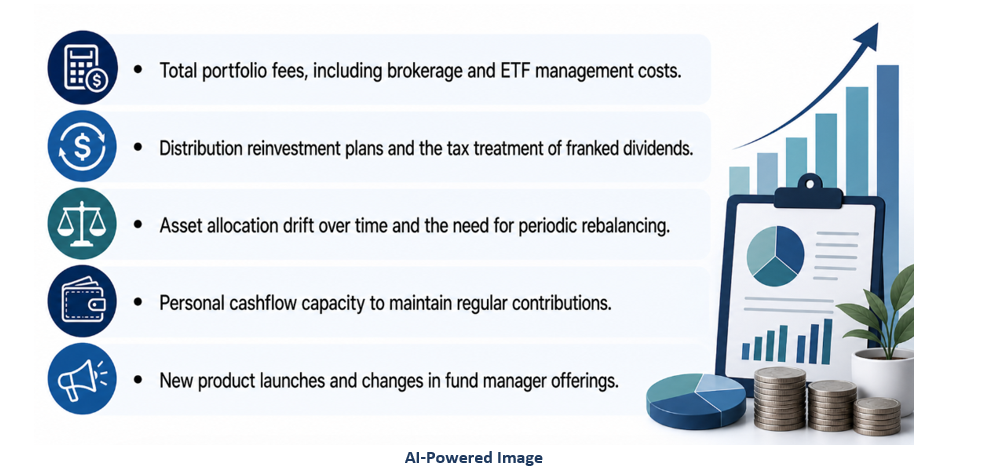
Brokerage costs, ETF management fees, and the spread between the bid and ask prices on smaller ETFs can all affect returns. Investors are watching new product launches, particularly in low-cost broad-market and themed ETFs. They are also watching changes to the regulatory landscape, including disclosure requirements and reporting standards that affect product comparability.
Balanced conclusion
Turning $250 a month into a long-term ASX share portfolio is less about identifying any single share and more about consistency, diversification and discipline. Modest amounts, invested patiently, have the potential to grow into substantial sums over multi-decade horizons. The strategy carries market risk and requires resilience during downturns, but the framework is one that has been used by many Australian investors over many cycles. Combining regular contributions with a clear plan and an awareness of fees and tax can produce outcomes well above what a casual savings approach would deliver.
Frequently Asked Questions
Is $250 a month enough to start investing in ASX shares?
It can be a practical starting point, especially through ETFs and low-cost brokers. The exact suitability depends on individual goals, time horizon and other financial commitments. Many investors begin at this level and increase contributions as income grows.
How does dollar-cost averaging work?
It involves investing a fixed amount on a regular schedule, regardless of market conditions. The result is buying more units when prices are lower and fewer when prices are higher, smoothing the average entry price over time.
What is the role of ETFs in small monthly portfolios?
ETFs offer broad diversification through a single trade, which is useful when contribution amounts are modest. They typically provide exposure to many shares across sectors or geographies and have lower management costs than many active funds.
What are the main risks of regular investing?
Market risk, sequence-of-returns risk, behavioural risk during downturns and the cumulative impact of fees are among the most common considerations. Currency risk also matters for global ETFs that are not currency-hedged.


 Nov 12, 2026





 Please wait processing your request...