
 CA
 NZ
 UK
 US
 IND

 AU

 Share
 X (Formerly Twitter)
 Whatsapp
 Facebook
 LinkedIn
 Telegram
 Email This Article
 Copy Link
 Summarize with AI
 Chat GPT
 Perplexity

Key Highlights
- The Wealth Curve reflects how financial productivity compounds gradually over long periods.
- Time plays a larger role in wealth creation than most short-term market movements.
- Income growth, investing, and reinvestment collectively shape long-term financial outcomes.
- Early financial discipline can create disproportionate advantages later in life.
- The steepest phase of wealth accumulation often occurs after years of consistent effort.
One of the most misunderstood aspects of wealth creation is how slowly it appears to progress in the early years. Many people expect visible financial improvement within short periods, but the wealth curve rarely behaves in a straight line.
In reality, financial productivity tends to compound quietly before becoming noticeable. During the early stages, savings may appear modest, investments may deliver limited visible gains, and career growth may feel incremental. Yet beneath the surface, financial foundations are gradually being built.
This early phase is often where people lose patience. Some abandon investing too soon, while others constantly shift strategies searching for faster results. However, the structure of compounding naturally rewards duration more than intensity.
The wealth curve is therefore less about immediate acceleration and more about sustained momentum over time.
Compounding Extends Beyond Investments
When people hear the word “compounding,” they often think only about stock market returns. But financial productivity compounds across multiple areas simultaneously.
Skills compound. Experience compounds. Professional relationships compound. Reputation compounds. Even financial habits compound over decades.
A person who steadily improves their earning capability while consistently investing a portion of income creates multiple layers of compounding at the same time. Over long periods, this combination can significantly reshape financial outcomes.
The effect becomes more visible with time because each layer starts reinforcing the others. Higher skills may lead to better income opportunities. Better income may increase Investment capacity. Investments may generate passive returns that further strengthen financial flexibility.
The wealth curve is therefore not driven by one decision alone, but by repeated productive actions sustained over years.
Time Changes the Shape of the Curve
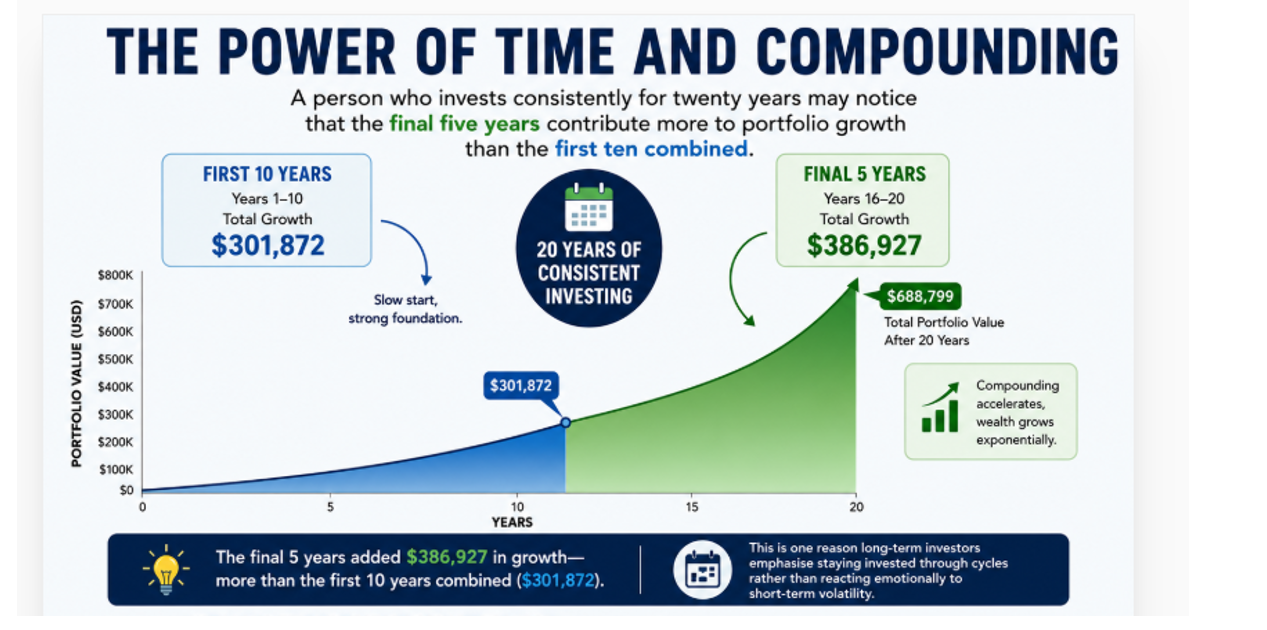
One of the defining characteristics of the wealth curve is that the steepest gains usually occur later rather than earlier.
This happens because returns begin generating additional returns. Over time, reinvested growth can become larger than the original contributions themselves.
For example, a person who invests consistently for twenty years may notice that the final five years contribute more to portfolio growth than the first ten combined. This is one reason long-term investors often emphasise staying invested through cycles rather than reacting emotionally to short-term Volatility.
The concept applies beyond markets as well. Businesses often experience years of slow progress before reaching scale. Careers may involve extended periods of learning before significant income expansion occurs.
The wealth curve rewards persistence because compounding needs time to fully develop.
Productivity Matters More Than Appearances
Modern financial culture often focuses heavily on visible consumption rather than productive asset building. Expensive purchases can create the appearance of wealth, but the wealth curve is fundamentally linked to productive financial behaviour.
Assets that generate income, appreciate in value, or improve future earning capability tend to contribute more meaningfully to long-term financial growth than purely consumptive spending.
This does not mean avoiding enjoyment or eliminating discretionary spending entirely. Instead, it highlights the importance of balancing present consumption with future financial productivity.
People who consistently direct part of their resources toward productive outcomes often place themselves in stronger financial positions later in life.
The wealth curve therefore reflects not only how much money is earned, but also how effectively financial energy is allocated.
Why Patience Becomes a Financial Advantage
Patience is frequently underestimated in finance because short-term outcomes dominate attention. Daily market fluctuations, social comparisons, and rapid success stories can distort expectations around wealth creation.
However, long-term financial productivity usually depends more on consistency than dramatic single events.
Many financially successful individuals spent years operating in relatively ordinary ways — saving regularly, investing steadily, improving skills gradually, and avoiding major financial setbacks. Over time, those behaviours compounded into significantly different outcomes.
The wealth curve highlights an important reality: wealth often appears to accelerate suddenly, but that acceleration is usually the result of years of invisible compounding already taking place.
FAQs
Q: What is the Wealth Curve?
A:The Wealth Curve describes how financial productivity and wealth accumulation compound over time, often starting slowly before accelerating in later years.
Q: Why does wealth growth appear slow in the beginning?
A:Early stages of compounding typically produce smaller visible results because investment returns and income growth are building from a lower base.
Q: Does the Wealth Curve only apply to investing?
A:No. The concept also applies to skills, career growth, Business development, networking, and financial habits that improve productivity over time.
Q: Why is patience important in wealth creation?
A:Compounding requires time. Long-term consistency often produces larger outcomes than short-term attempts to generate rapid financial gains.


 Nov 12, 2026





 Please wait processing your request...