
 CA
 NZ
 UK
 US
 IND

 AU

 Share
 X (Formerly Twitter)
 Whatsapp
 Facebook
 LinkedIn
 Telegram
 Email This Article
 Copy Link
 Summarize with AI
 Chat GPT
 Perplexity

Highlights
- Fuel prices and Supply availability have negatively impacted 72 per cent of Australian businesses
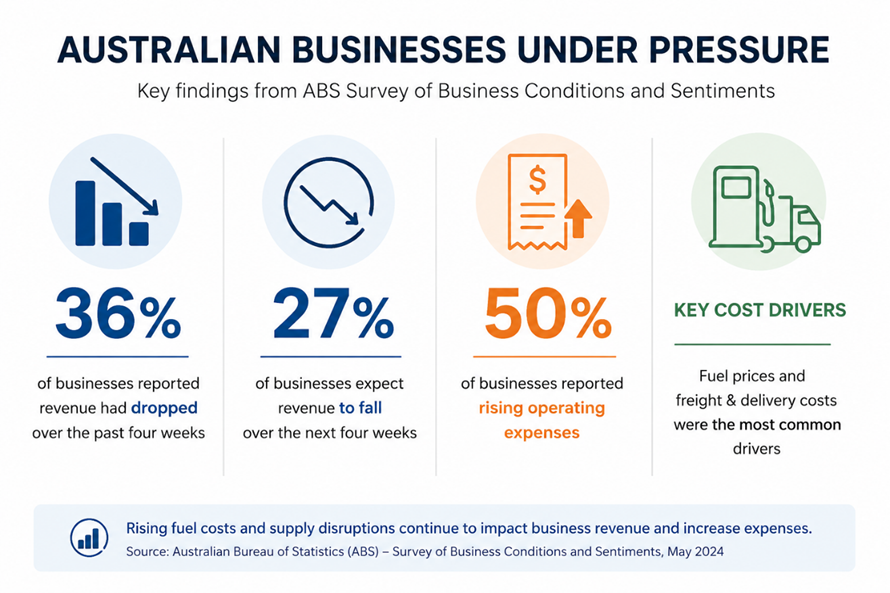
- Over one third (36 per cent) of businesses reported Revenue had dropped over the past four weeks
- More than a quarter (27 per cent) expect revenue to fall over the next four weeks
- Half of all businesses reported operating expenses had risen due to fuel and freight costs
- About 60 per cent of businesses changed operations in response to fuel price pressures
- One in four businesses (28 per cent) adjusted workforce activity due to fuel-related constraints
The latest data released by the Australian Bureau of Statistics (ABS) reveals significant economic pressure on Australian businesses due to rising fuel costs and supply disruptions. According to the Survey of Business Conditions and Sentiments, fuel price Volatility and global supply chain disruptions have had a broad-based impact across industries, with 72 per cent of businesses reporting negative effects from fuel prices and availability. The disruption has been linked in part to global geopolitical tensions, including the closure of the Strait of Hormuz, which has heightened uncertainty in energy markets. ABS head of business statistics Tom Lay noted that businesses across all industries have been affected by rising fuel costs and ongoing supply chain challenges, with transport, logistics, agriculture, and small businesses among the most impacted sectors.
Implications for Funds Management and Market Risk
From a funds management perspective, these conditions represent a material shift in cost structures and risk exposure across portfolios. Rising fuel costs directly affect operating margins for corporates, particularly those reliant on transportation, Manufacturing, and distribution networks. For fund managers, this translates into heightened Earnings volatility, increased Inflation sensitivity, and a greater need to reassess sector allocations. Energy input shocks tend to flow through to broader price levels, meaning Equity valuations must account for persistent cost pressures rather than short-term spikes. Fixed income strategies may also face challenges as inflation expectations adjust and Central Bank policy remains responsive to cost-driven price increases.
Revenue Pressure and Margin Compression Across Industries
AI-Powered Image
The ABS data shows that over one third (36 per cent) of businesses reported revenue had dropped over the past four weeks, while more than a quarter (27 per cent) expect revenue to fall over the next four weeks. At the same time, half of all businesses reported rising operating expenses, with fuel prices and freight and delivery costs identified as the most common drivers. These trends highlight a compression in margins that is highly relevant for funds management decision-making, particularly in assessing Cash Flow resilience and Dividend sustainability across listed companies.
Operational Adjustments and Strategic Business Responses
In response to these pressures, about 60 per cent of businesses reported making operational changes in May due to fuel prices or availability. These included absorbing cost increases (48 per cent), increasing prices (11 per cent), changing or delaying production targets, schedules or volumes (6 per cent), and implementing fuel surcharges or levies (6 per cent). Additionally, roughly one in four businesses (28 per cent) adjusted workforce strategies, including reducing or suspending non-essential travel (15 per cent) and reducing workforce size (9 per cent). These adjustments indicate a shift in corporate behaviour that fund managers must Factor into forward-looking earnings models and risk assessments.
Funds Management Strategy in a High-Cost Fuel Environment
For funds management professionals, the key implication is the need to balance inflation-impacted sectors against those with pricing power or lower fuel dependency. Defensive positioning may become more attractive in periods of sustained energy volatility, while active managers may seek opportunities in firms able to pass through costs without significant Demand destruction. Scenario analysis, stress testing, and supply chain exposure mapping become essential tools in navigating this environment. Ultimately, fuel-driven cost inflation is not only a macroeconomic issue but a portfolio construction challenge that demands adaptive and data-driven Investment strategies.


 Nov 12, 2026





 Please wait processing your request...