
 CA
 NZ
 UK
 US
 IND

 AU

 Share
 X (Formerly Twitter)
 Whatsapp
 Facebook
 LinkedIn
 Telegram
 Email This Article
 Copy Link
 Summarize with AI
 Chat GPT
 Perplexity

Highlights
- Liquidity risk emerges when assets cannot be sold quickly without sharp price reductions.
- Market stress can cause buyers to vanish, amplifying price volatility across asset classes.
- Even traditionally liquid markets may face temporary breakdowns during extreme conditions.
- Liquidity constraints can spread rapidly, affecting funds, banks, and broader financial systems.
Liquidity refers to the ease with which an asset can be bought or sold in the market without materially affecting its price. Liquidity risk arises when this ease disappears, often at the same time for many market participants. While assets may appear liquid during stable periods, this condition can change abruptly during stress events. Liquidity risk is less about long-term value and more about timing, market depth, and the availability of willing buyers.
In normal conditions, markets function smoothly because there is a balance between buyers and sellers. When that balance breaks, the ability to exit positions becomes uncertain, exposing participants to unexpected losses or delays.
What Triggers a Liquidity Crunch?
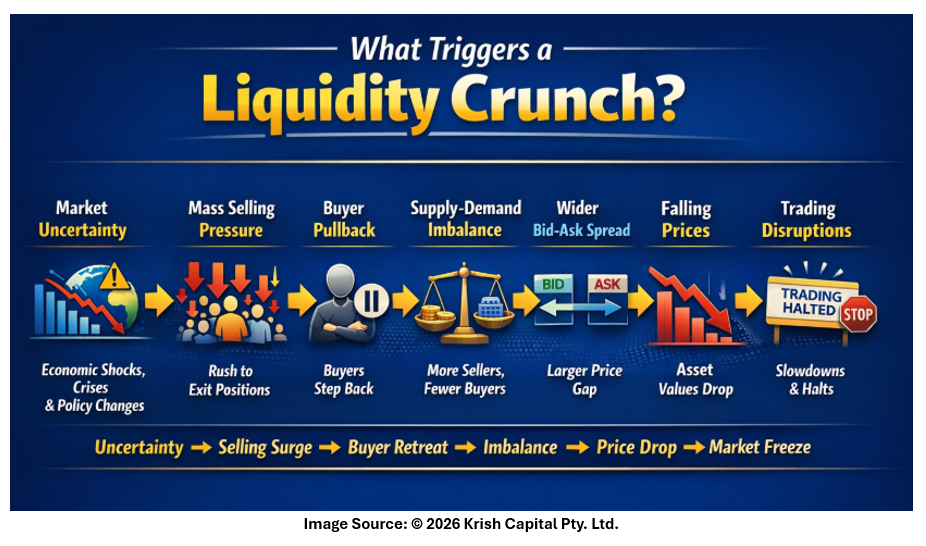
Liquidity risk often surfaces during periods of heightened uncertainty. Events such as economic shocks, financial crises, policy changes, or sudden shifts in market sentiment can prompt many participants to exit positions simultaneously. When this happens, selling pressure increases sharply.
As more sellers enter the market, buyers may step back, waiting for prices to stabilise. This mismatch between supply and demand leads to wider bid-ask spreads and falling prices. In extreme cases, trading may slow significantly or halt altogether, not because assets lack value, but because there are too few buyers at prevailing prices.
When Everyone Tries to Exit at Once
A crowded exit is one of the most visible expressions of liquidity risk. When many participants attempt to sell the same asset or asset class at the same time, prices can decline rapidly. These declines may exceed what would be expected based on fundamentals alone.
This dynamic is often self-reinforcing. Falling prices can trigger margin calls, redemptions, or risk-management rules, prompting further selling. As liquidity dries up, even small trades can move prices substantially, increasing volatility and uncertainty.
Importantly, assets that are considered liquid under normal conditions—such as government bonds or large-cap equities—are not immune. During severe stress, liquidity can become fragmented or temporarily unavailable, highlighting how dependent markets are on confidence and participation.
Systemic Implications of Liquidity Risk
Liquidity risk does not remain confined to individual assets. It can spread across markets and institutions. For example, investment funds facing redemption requests may be forced to sell assets quickly, affecting market prices. Banks and financial intermediaries may reduce market-making activities to limit their own exposure, further reducing available liquidity.
This interconnectedness means liquidity stress in one area can influence others. As confidence weakens, participants may hoard cash, amplifying the shortage of liquidity. Central banks and regulators often monitor these conditions closely due to their potential to disrupt financial stability.
Lessons from Past Market Disruptions
Historical episodes demonstrate how quickly liquidity can evaporate. During financial crises, markets have experienced sharp price swings, trading freezes, and forced asset sales. These events underline the importance of understanding liquidity as a dynamic condition rather than a fixed attribute.
They also show that liquidity risk is often underestimated during calm periods. When markets function smoothly, the assumption that exits will always be available can go untested, until stress reveals underlying vulnerabilities.
Why Liquidity Risk Matters
Liquidity risk shapes how markets behave under pressure. It explains why prices can fall faster than expected and why diversification may not always protect against short-term disruptions. Understanding this risk provides insight into market dynamics during periods of collective stress.
By recognising how liquidity can vanish when everyone tries to exit at once, market participants and observers gain a clearer picture of why volatility increases and why market functioning can change so rapidly during times of uncertainty.


 Nov 12, 2026





 Please wait processing your request...