
 CA
 NZ
 UK
 US
 IND

 AU

 Share
 X (Formerly Twitter)
 Whatsapp
 Facebook
 LinkedIn
 Telegram
 Email This Article
 Copy Link
 Summarize with AI
 Chat GPT
 Perplexity

Highlights
- Soft-dollar arrangements allow funds to “pay” for research with trading commissions instead of cash.
- They can grant access to valuable independent research and data otherwise unaffordable for smaller funds.
- But they often lack transparency, hide costs, and can create conflicts of interest.
- Regulators permit soft dollars under safe-harbor rules, but meaningful disclosure and oversight remain critical.
Soft-dollar arrangements refer to the practice in which investment managers (mutual funds, hedge funds, etc.) pay for research, data services, or other non-execution services not with direct cash (hard dollars), but indirectly via commissions generated from trading activity. Rather than writing a cheque to a research vendor, the fund routes trades through brokers who charge slightly higher commissions; the excess commission is used to “pay for” the research or services.
Under this structure, a broker executes the trades and also provides, for example, analyst reports, market data feeds, software tools, or access to independent research, bundled as part of the broker’s offerings. For the adviser, soft dollars provide a way to fund research without reducing the fund’s cash reserves directly.
Access to Broader, Often Independent, Research
One of the key advantages of soft-dollar arrangements is that funds gain access to a wider variety of research offerings — including third-party independent research firms that may not have investment-banking ties. That expands the universe of ideas, potentially including coverage of smaller or under-researched companies.
This expanded research pool can improve investment decision-making. For example, access to detailed analyst reports, data analytics platforms, or specialized market intelligence may give fund managers deeper insight than in-house research alone.
Cost-Efficient for Managers (Especially Smaller Firms)
For many investment firms — particularly smaller ones — using commission dollars (soft dollars) instead of cash may be more cost-efficient. It allows them to tap into high-quality research and data without upfront cash outlays.
From a resource-allocation standpoint, soft dollars enable consolidation of services (execution, research, analytics), allowing fund advisers to leverage bundled offerings rather than sourcing each service separately.
Potential Positive Spill-over to Market Efficiency
Some proponents argue that because soft dollars make independent research more economically viable, coverage expands — especially for smaller or less-followed firms. That broader coverage might lead to greater market efficiency, more liquidity, and narrower spreads, benefiting all investors.
Risks and Criticisms Associated with Soft-Dollar Arrangements
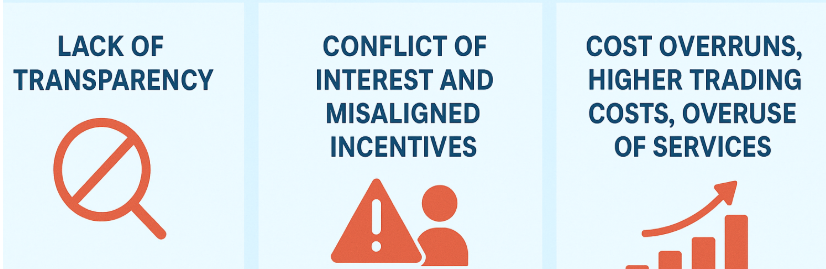
Image Source: © 2025 Krish Capital Pty. Ltd
Lack of Transparency
A major critique is that soft-dollar costs are not always transparent to the ultimate investors. Since the expenses are embedded in trade commissions, they often do not appear in a fund’s standard expense ratio or fee summary. Investors may not realize how much is being spent on research, or what quality of services they receive.
Even when disclosure is provided, it may appear only in complex or “back-end” documents like a Statement of Additional Information, not in easily digestible investor materials — making cost comparisons across funds difficult.
Conflict of Interest and Misaligned Incentives
Soft-dollar arrangements create a potential conflict of interest: advisers might direct trades to brokers that offer generous research-for-commission deals, rather than those offering the best execution price or lowest commission. That undermines the principle of “best execution” for clients.
In some instances, research-for-commission arrangements have been abused — brokers or advisers using soft-dollar credits to pay for services unrelated to research (e.g., office rent, marketing, personal expenses). Regulatory inspections have flagged such misuse.
Cost Overruns, Higher Trading Costs, Overuse of Services
Because research and services under soft-dollar arrangements are “paid for” via trading commissions, there is less incentive to economize — advisers may engage in excessive trading to generate commission flow (sometimes called “over-trading”) to pay for more services. That can erode investor returns.
Also, since research cost is hidden, the fund’s apparent expense ratio may understate the total cost incurred by investors. Over time, those hidden costs can drag down net returns, especially for retail investors who may not scrutinize underlying commission expenses.
What Should you Know and Ask When Evaluating Funds
If you are evaluating or investing in an actively managed fund, especially one that trades frequently:
- Check whether the fund uses soft-dollar arrangements. Review the fund’s prospectus or Statement of Additional Information (SAI) for disclosure of broker-dealer commissions and services received.
- Ask whether the broker selection is based solely on best execution or also influenced by soft-dollar deals.
- Recognize that low expense ratio does not always mean low total cost — soft-dollar–generated research adds hidden expenses via commission load.
- Consider whether the additional research and data justify the cost overheads, particularly for long-term investors.
Summary & Conclusion
Soft-dollar arrangements occupy a gray area in fund management: on one hand, they enable access to a broader and often independent research pool, potentially improving investment decisions; on the other, they create opacity, possible conflicts of interest, and hidden costs that may erode investor returns. While regulatory frameworks like Section 28(e) provide a safe harbor and require disclosure, the effectiveness of those safeguards depends heavily on the adviser’s integrity and transparency. For investors — especially in actively managed funds — soft dollars matter. Awareness, critical evaluation, and informed questioning are essential to ensure that research benefits are real, and not just a vehicle for obscured costs or misaligned incentives.


 Nov 12, 2026





 Please wait processing your request...