
 CA
 NZ
 UK
 US
 IND

 AU

 Share
 X (Formerly Twitter)
 Whatsapp
 Facebook
 LinkedIn
 Telegram
 Email This Article
 Copy Link
 Summarize with AI
 Chat GPT
 Perplexity

Highlights
- Concentrated funds may outperform when a few high-conviction positions deliver strong returns.
- Diversified portfolios can help manage volatility and reduce company-specific risks.
- Market conditions often determine whether focus or broad exposure has the edge.
- Many investors are increasingly exploring a balance between concentration and diversification.
Few questions in investing have generated as much enduring debate as whether it is better to back a small number of high-conviction ideas or spread capital across a broader range of opportunities. The tension between concentration and diversification sits at the core of fund construction, shaping risk, return potential, and how portfolios behave through different market cycles.
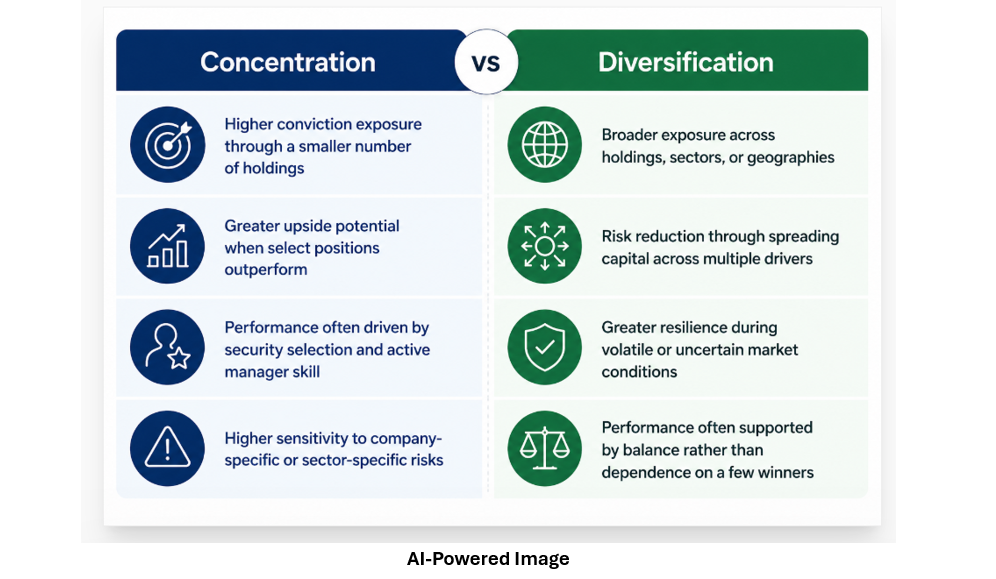
At its simplest, concentrated investing involves allocating capital to a relatively limited number of holdings, often reflecting a manager’s strongest convictions. Diversification, by contrast, seeks exposure across a wider set of securities, sectors, or geographies to reduce dependence on any single outcome.
Both approaches have long histories, and both have delivered success under different conditions. Increasingly, the question is not which is universally better, but what is driving performance at a given point in time.
When Concentration Can Lift Returns
Concentrated portfolios often attract attention when markets reward a narrow group of leaders. In periods where a small number of companies dominate index returns — as seen at various points in technology, resources, or healthcare — funds with heavier exposure to those outperformers can generate outsized gains.
This approach often rests on the belief that deep research and selectivity can identify businesses with superior earnings potential, structural advantages, or valuation dislocations. Rather than diluting upside across dozens or hundreds of holdings, concentration allows those ideas to have meaningful impact on returns.
For active managers, this can also be a way to differentiate from benchmarks. If a fund holds many of the same positions as an index at similar weights, its performance may not differ materially. Concentration can create the possibility of true excess return, though not without trade-offs.
The Risk Side of Focused Portfolios
The same characteristics that can amplify upside can also magnify downside. A concentrated portfolio may be more exposed to company-specific setbacks, sector weakness, or sudden shifts in investor sentiment.
A regulatory change, earnings miss, or geopolitical event affecting one or two major positions can have disproportionate effects. That is why concentrated strategies can often exhibit higher volatility, even when long-term return potential appears attractive.
This does not make concentration inherently riskier in all contexts, but it does make outcomes more dependent on security selection. In practical terms, success often hinges not just on picking winners, but avoiding large mistakes.
Why Diversification Still Matters
Diversification has often been described as a way of managing uncertainty rather than maximising upside. By spreading exposure, investors may reduce the impact of any one holding performing poorly.
That principle has helped diversified funds navigate difficult periods, particularly when market leadership rotates rapidly or when shocks emerge unexpectedly. Broad exposure can also provide participation across multiple growth drivers rather than relying on one theme or sector.
Importantly, diversification is not only about the number of holdings. It can involve balancing styles, industries, asset classes, and regions. A portfolio with many stocks can still be concentrated in economic exposure, while a smaller portfolio can sometimes be diversified by underlying drivers.
In periods marked by heightened volatility or uncertain macro conditions, that distinction can matter.
What Often Drives Performance
Fund performance is rarely explained by concentration or diversification alone. Manager skill, valuation discipline, market regime, and risk management often play equally significant roles.
During momentum-driven markets, concentration may appear to be the winning formula. During broader or more fragmented rallies, diversified portfolios may hold up better. Rising interest rates, inflation shifts, commodity cycles, and geopolitical developments can all alter which style is favoured.
This is why some investors increasingly focus less on choosing one philosophy over the other and more on understanding how each fits within an overall portfolio.
Finding the Balance
In practice, many successful strategies sit somewhere between the two extremes. A portfolio may hold a diversified core while allowing greater weight in a smaller number of high-conviction ideas. Others may combine concentrated active funds with broader passive exposures.
That blended approach reflects a growing recognition that concentration and diversification are not necessarily opposites, but tools that can be adjusted depending on objectives, time horizon, and risk tolerance.
For long-term investors, the question may be less about picking sides and more about asking what degree of focus supports the outcomes they seek.
The Bigger Picture for Investors
The debate between concentration and diversification is unlikely to be settled because both approaches respond to different market realities. Concentrated funds may capture more upside when conviction proves correct, while diversified portfolios may offer resilience when uncertainty rises.
What often drives fund performance is not concentration alone, nor diversification alone, but how effectively each is applied.
For investors, understanding that distinction can be as important as choosing the fund itself.
FAQs
Is a concentrated fund always riskier than a diversified fund?
Not necessarily, though concentrated funds can have greater exposure to individual holdings or sectors, which may increase volatility.
Can diversified funds still outperform concentrated funds?
Yes. In broad-based or volatile markets, diversified strategies may perform well while reducing downside risk.
How many holdings make a portfolio concentrated?
There is no fixed number, though concentrated funds often hold materially fewer positions than broad-market funds.
Can investors combine both approaches?
Many investors do, using diversified core exposures alongside more focused strategies to balance risk and opportunity.


 Nov 12, 2026





 Please wait processing your request...